Trigonometry: Ratios, Heights and Distances formulas
At a glance
sin = opp/hyp,  cos = adj/hyp,  tan = opp/adj = sin/cos
cosec = 1/sin,  sec = 1/cos,  cot = 1/tan
sin: 0, 1/2, 1/√2, √3/2, 1 at 0°, 30°, 45°, 60°, 90° (cos reversed)
sin² + cos² = 1,  1 + tan² = sec²,  1 + cot² = cosec²
sin(90° − θ) = cos θ,  tan(90° − θ) = cot θ,  sec(90° − θ) = cosec θ
Quadrants: All, Sin, Tan, Cos positive in I, II, III, IV
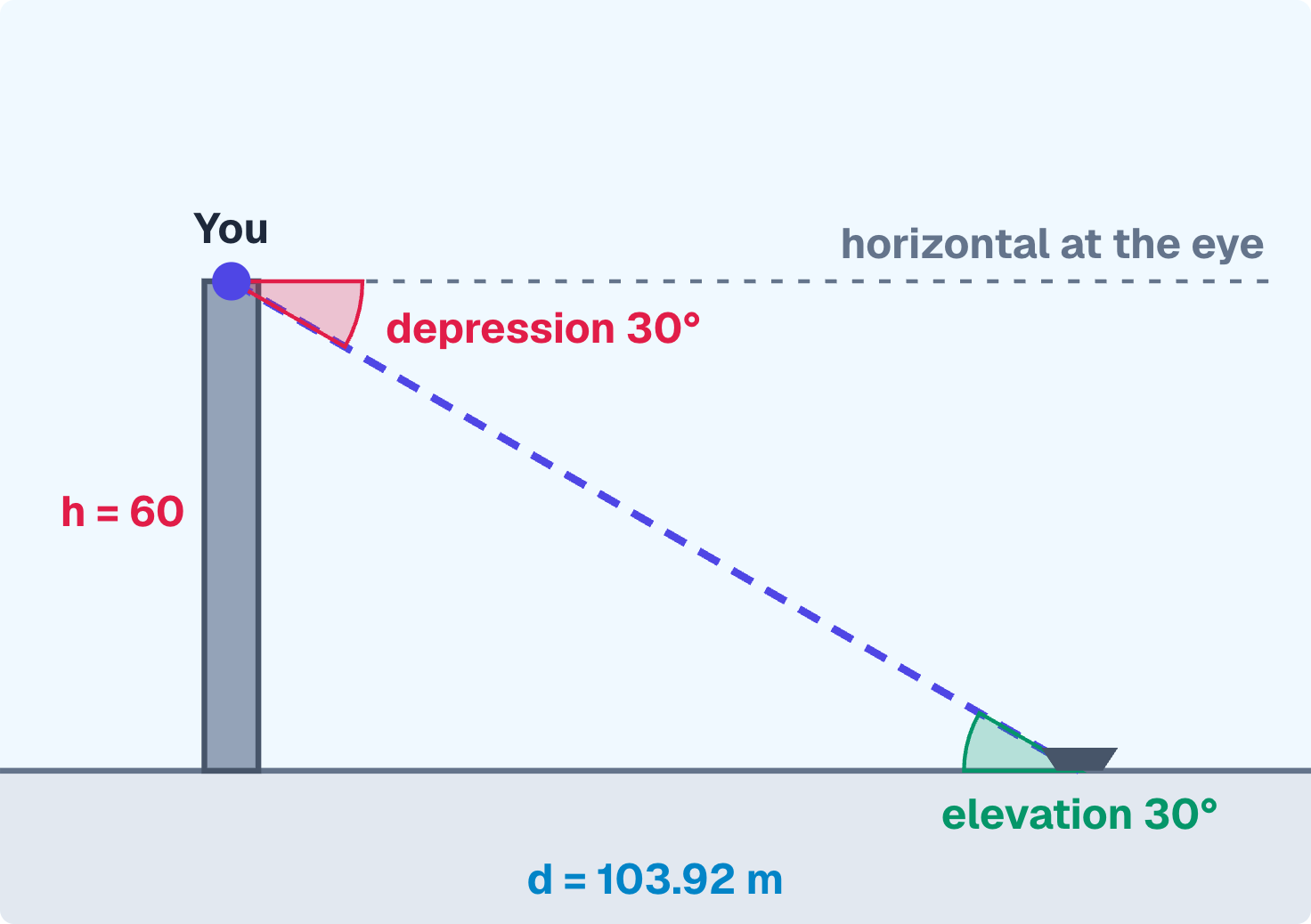
height = distance × tan(elevation);  depression = elevation from below
Same side: AB = h(cot α − cot β);  30° → 60° walk = 2 × remaining
Area = ½ab sin C = abc/(4R);  a/sin A = 2R
a² = b² + c² − 2bc cos A
sin(A ± B) = sin A cos B ± cos A sin B;  sin 2A = 2 sin A cos A
The six ratios in a right triangle
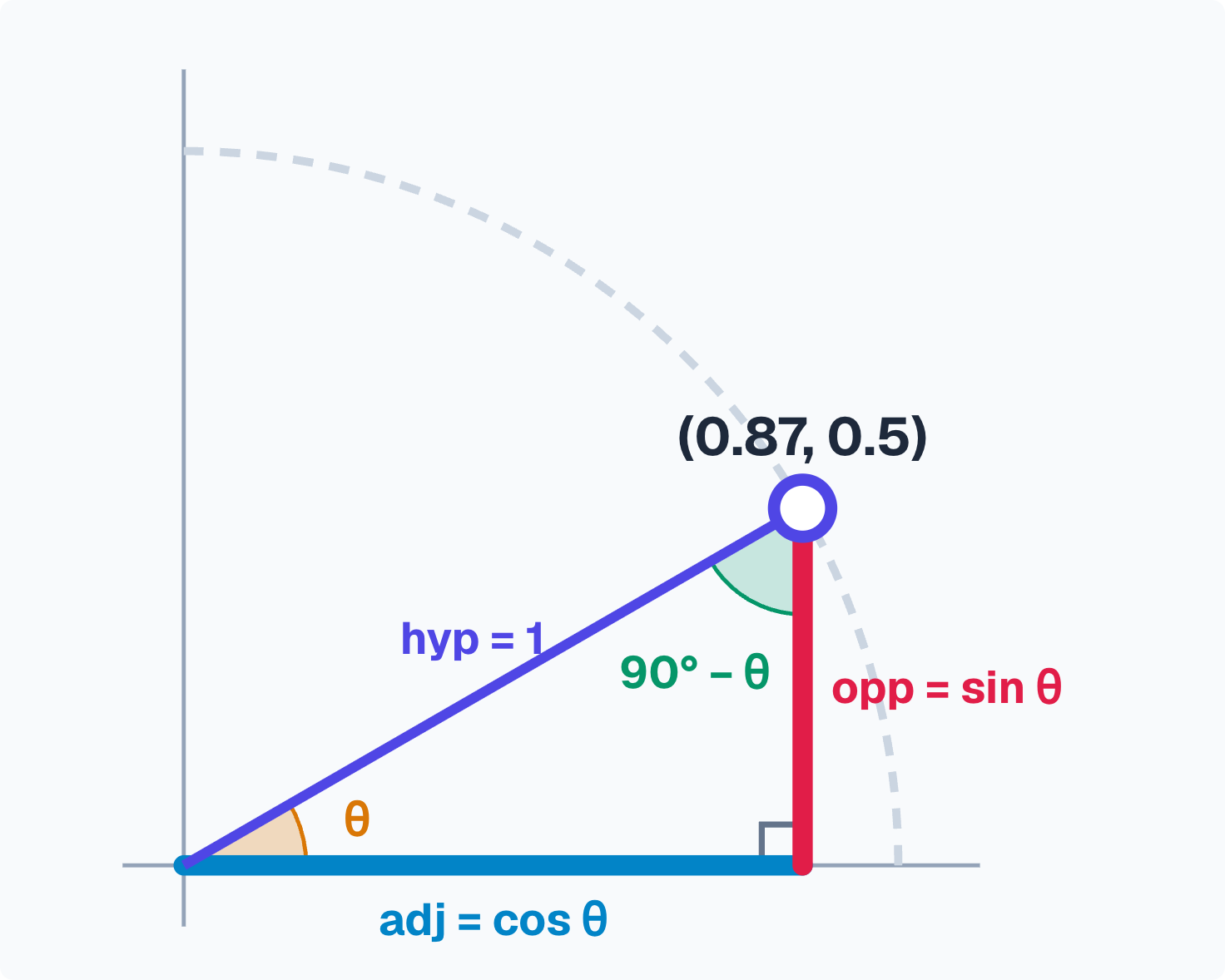
sin θ = opposite / hypotenuse      cosec θ = 1 / sin θ
cos θ = adjacent / hypotenuse      sec θ = 1 / cos θ
tan θ = opposite / adjacent        cot θ = 1 / tan θ
tan θ = sin θ / cos θ              cot θ = cos θ / sin θ
Standard values: 0°, 30°, 45°, 60°, 90°
| Ratio | 0° | 30° | 45° | 60° | 90° |
|---|---|---|---|---|---|
| sin | 0 | 1/2 | 1/√2 | √3/2 | 1 |
| cos | 1 | √3/2 | 1/√2 | 1/2 | 0 |
| tan | 0 | 1/√3 | 1 | √3 | not defined |
| cosec | not defined | 2 | √2 | 2/√3 | 1 |
| sec | 1 | 2/√3 | √2 | 2 | not defined |
| cot | not defined | √3 | 1 | 1/√3 | 0 |
1/√2 = √2/2 ≈ 0.707, √3/2 ≈ 0.866, 1/√3 = √3/3 ≈ 0.577, √3 ≈ 1.732.
Shortcut: The sin row is √0/2, √1/2, √2/2, √3/2, √4/2 for 0°, 30°, 45°, 60°, 90°. The cos row is the same list backwards. Then tan = sin ÷ cos, and the last three rows are just reciprocals.
Identities and complementary angles
sin²θ + cos²θ = 1             →  cos²θ = 1 − sin²θ
1 + tan²θ = sec²θ             →  (sec θ − tan θ)(sec θ + tan θ) = 1
1 + cot²θ = cosec²θ           →  (cosec θ − cot θ)(cosec θ + cot θ) = 1
Shortcut: Since (sec θ − tan θ)(sec θ + tan θ) = 1, if sec θ + tan θ = p then sec θ − tan θ = 1/p. Add and subtract to get sec θ and tan θ separately. The same trick works for cosec θ and cot θ.
sin(90° − θ) = cos θ          cos(90° − θ) = sin θ
tan(90° − θ) = cot θ          cot(90° − θ) = tan θ
sec(90° − θ) = cosec θ        cosec(90° − θ) = sec θ
So tan θ × tan(90° − θ) = 1   and   sin²θ + sin²(90° − θ) = 1
Shortcut: a sin θ + b cos θ always lies between −√(a² + b²) and +√(a² + b²); so 3 sin θ + 4 cos θ is at most 5. For positive a and b, a² tan²θ + b² cot²θ is at least 2ab (AM ≥ GM, since the product of the two terms is a²b²).
Heights and distances: elevation and depression
height = distance × tan(elevation)
distance = height × cot(elevation)
line of sight = distance × sec(elevation) = height × cosec(elevation)
Two observers and moving observers
Same side (A farther):  AB = h(cot α − cot β),  so  h = AB / (cot α − cot β)
Opposite sides:  AB = h(cot α + cot β)
Angles complementary from distances p and q:  h = √(pq)
Shortcut: At 30° the distance is h√3; at 60° it is h/√3, a third of that. So the walk from 30° to 60° is twice the remaining distance, and h = (√3/2) × the walk. This one pattern answers a large share of CAT heights questions.
Beyond 90°, and sums of angles
| Quadrant | Angles | Positive | Negative |
|---|---|---|---|
| I | 0° to 90° | all six | none |
| II | 90° to 180° | sin, cosec | cos, sec, tan, cot |
| III | 180° to 270° | tan, cot | sin, cosec, cos, sec |
| IV | 270° to 360° | cos, sec | sin, cosec, tan, cot |
sin(180° − θ) = sin θ      cos(180° − θ) = −cos θ     tan(180° − θ) = −tan θ
sin(180° + θ) = −sin θ     cos(180° + θ) = −cos θ     tan(180° + θ) = tan θ
sin(−θ) = −sin θ           cos(−θ) = cos θ            (360° ± θ behaves like ±θ)
sin(A ± B) = sin A cos B ± cos A sin B
cos(A ± B) = cos A cos B ∓ sin A sin B
tan(A ± B) = (tan A ± tan B) / (1 ∓ tan A tan B)
sin 2A = 2 sin A cos A
cos 2A = cos²A − sin²A = 1 − 2 sin²A = 2 cos²A − 1
tan 2A = 2 tan A / (1 − tan²A)
Any triangle: area, sine rule and cosine rule
a / sin A = b / sin B = c / sin C = 2R
Area = ½ab sin C = ½bc sin A = ½ca sin B
Area = abc / (4R)
a² = b² + c² − 2bc cos A        cos A = (b² + c² − a²) / (2bc)
A = 60°:  a² = b² + c² − bc
A = 90°:  a² = b² + c²
A = 120°: a² = b² + c² + bc
Shortcut: Sides are in the ratio of the sines of their opposite angles. Angles 30°, 60°, 90° give sides 1 : √3 : 2; angles 30°, 30°, 120° give 1 : 1 : √3; angles 45°, 45°, 90° give 1 : 1 : √2.
Formulas stick when you use them
The Trigonometry: Ratios, Heights and Distances lesson has worked problems and quick checks for every formula here. Free to start.
Start free