Coordinate Geometry formulas
At a glance
AB = √(Δx² + Δy²)       midpoint = average of coordinates
m : n internal: (m·x₂ + n·x₁)/(m + n)   external: (m·x₂ − n·x₁)/(m − n)
centroid = (Σx/3, Σy/3)   incentre = (Σa·x/(a + b + c), Σa·y/(a + b + c))
m = Δy/Δx = tan θ;  ax + by + c = 0 → m = −a/b
y − y₁ = m(x − x₁)   x/a + y/b = 1   two-point: slope from both points
parallel: m₁ = m₂     perpendicular: m₁m₂ = −1 (a₁a₂ + b₁b₂ = 0)
angle between lines: tan θ = |(m₁ − m₂)/(1 + m₁m₂)|
point to line: |ax₁ + by₁ + c| / √(a² + b²)   parallel lines: |c₁ − c₂| / √(a² + b²)
area = ½ |Σ(xᵢyᵢ₊₁ − xᵢ₊₁yᵢ)|;  area 0 ⇔ collinear
circle: (x − h)² + (y − k)² = r²;  general: centre (−g, −f), r = √(g² + f² − c)
reflect: x-axis (x, −y), y = x (y, x), point (a, b) → (2a − x, 2b − y)
|x| + |y| ≤ a → 2a²     |x|/a + |y|/b ≤ 1 → 2ab
Distance and the midpoint
AB = √((x₂ − x₁)² + (y₂ − y₁)²)
distance from the origin = √(x² + y²)
midpoint = ((x₁ + x₂)/2, (y₁ + y₂)/2)
Shortcut: Legs of 3 and 4, 6 and 8, 5 and 12 or 8 and 15 give distances 5, 10, 13 and 17. CAT picks such points on purpose, so look for the triple before you square anything.
Section formula: splitting a segment
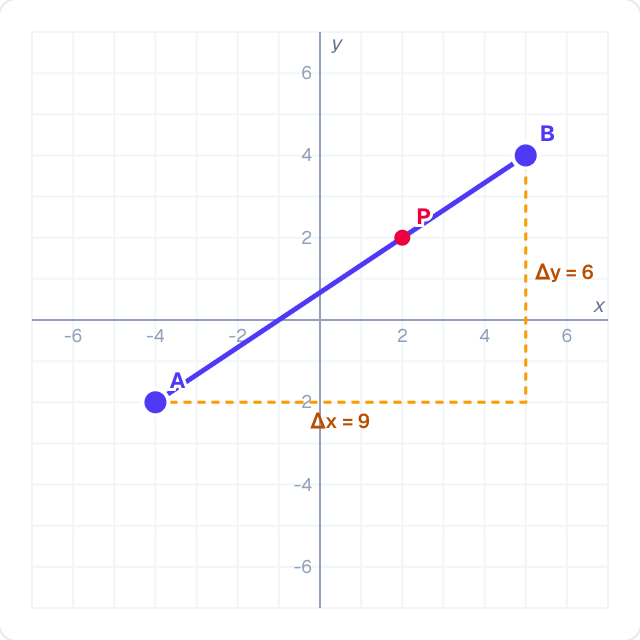
internal:  P = ((m·x₂ + n·x₁)/(m + n), (m·y₂ + n·y₁)/(m + n))
external:  P = ((m·x₂ − n·x₁)/(m − n), (m·y₂ − n·y₁)/(m − n))
midpoint:  m = n = 1
centroid:  G = ((x₁ + x₂ + x₃)/3, (y₁ + y₂ + y₃)/3)
incentre:  I = ((a·x₁ + b·x₂ + c·x₃)/(a + b + c), (a·y₁ + b·y₂ + c·y₃)/(a + b + c)),  a, b, c = sides opposite vertices 1, 2, 3
line ax + by + c = 0 cuts PQ in the ratio −L(P) : L(Q), with L(x, y) = ax + by + c
Shortcut: The y-axis divides AB in the ratio −x₁ : x₂, and the x-axis in −y₁ : y₂. A positive ratio means an internal cut; a negative one means the axis meets the line outside AB.
Slope and the equation of a line
slope m = (y₂ − y₁)/(x₂ − x₁) = tan θ
slope-intercept:  y = mx + c   (c = y-intercept)
point-slope:      y − y₁ = m(x − x₁)
two-point:        (y − y₁)/(y₂ − y₁) = (x − x₁)/(x₂ − x₁)
intercept form:   x/a + y/b = 1   (cuts the axes at a and b)
general:  ax + by + c = 0  →  m = −a/b, intercepts −c/a and −c/b
| Slope m | Angle θ | The line |
|---|---|---|
| m > 0 | 0° < θ < 90° | rises from left to right |
| m < 0 | 90° < θ < 180° | falls from left to right |
| m = 0 | θ = 0° | horizontal: y = k |
| not defined | θ = 90° | vertical: x = k |
| m = 1 | θ = 45° | y = x and lines parallel to it |
| m = −1 | θ = 135° | y = −x and lines parallel to it |
| m = √3, 1/√3 | θ = 60°, 30° | steep, gentle |
Shortcut: For ax + by + c = 0, read the slope straight off as −a/b. For 3x − 2y + 4 = 0 that is −3/(−2) = 3/2, with no rearranging.
Parallel and perpendicular lines
parallel:       m₁ = m₂
perpendicular:  m₁ × m₂ = −1   (or a₁a₂ + b₁b₂ = 0)
parallel to ax + by + c = 0:       ax + by + k = 0
perpendicular to ax + by + c = 0:  bx − ay + k = 0
angle θ between two lines:  tan θ = |(m₁ − m₂)/(1 + m₁m₂)|
Shortcut: y = 2x + 1 and y = −3x + 4: tan θ = |(2 − (−3))/(1 + 2 × (−3))| = |5/(−5)| = 1, so the lines meet at 45° (and 135°). When 1 + m₁m₂ = 0 the tangent is undefined: the lines are perpendicular.
Shortcut: Never compute a slope to build these lines. Parallel: keep a and b. Perpendicular: swap a and b and change one sign. Then fix k by plugging in the given point.
Distance from a point to a line
from (x₁, y₁) to ax + by + c = 0:   d = |ax₁ + by₁ + c| / √(a² + b²)
from the origin:                      d = |c| / √(a² + b²)
between ax + by + c₁ = 0 and ax + by + c₂ = 0:   d = |c₁ − c₂| / √(a² + b²)
Area from coordinates and collinearity
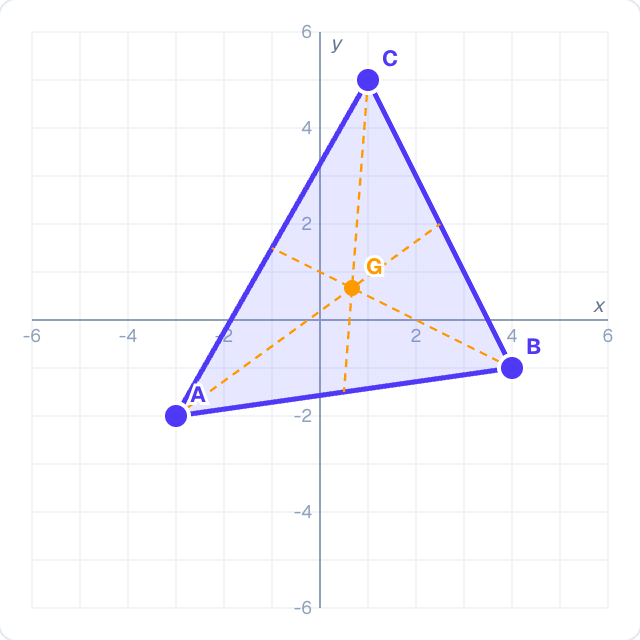
area = ½ |x₁(y₂ − y₃) + x₂(y₃ − y₁) + x₃(y₁ − y₂)|
shoelace: ½ |Σ (xᵢyᵢ₊₁ − xᵢ₊₁yᵢ)|, going round in order
one vertex at the origin:  ½ |x₁y₂ − x₂y₁|
collinear  ⇔  area = 0
Shortcut: Shift the triangle so one vertex sits at the origin (subtract its coordinates from the others). The area is then just ½ |x₁y₂ − x₂y₁| with two small numbers.
The equation of a circle
standard:  (x − h)² + (y − k)² = r²
general:   x² + y² + 2gx + 2fy + c = 0
centre (−g, −f),   r = √(g² + f² − c)
diameter from (x₁, y₁) to (x₂, y₂):  (x − x₁)(x − x₂) + (y − y₁)(y − y₂) = 0
y = mx + c touches x² + y² = r²  ⇔  c² = r²(1 + m²)
point P: S = x₁² + y₁² + 2gx₁ + 2fy₁ + c  <0 inside, =0 on, >0 outside
Shortcut: Centre in one glance: halve the x and y coefficients and flip their signs. x² + y² − 4x + 6y − 3 = 0 has centre (2, −3).
Reflections and regions
in the x-axis: (x, −y)      in the y-axis: (−x, y)
in y = x: (y, x)            in y = −x: (−y, −x)
in the origin: (−x, −y)     in the point (a, b): (2a − x, 2b − y)
|x| + |y| ≤ a:          area 2a²
|x|/a + |y|/b ≤ 1:      rhombus, area 2ab
|x − h| + |y − k| ≤ a:  same as |x| + |y| ≤ a, shifted: area 2a²
Formulas stick when you use them
The Coordinate Geometry lesson has worked problems and quick checks for every formula here. Free to start.
Start free