Lines, Angles and Triangles formulas
At a glance
Parallels: corresponding =, alternate =, co-interior sum 180°
A + B + C = 180°   exterior = sum of opposite interiors
|a − b| < c < a + b
c² = a² + b² right, > obtuse, < acute
45-45-90 → 1 : 1 : √2   30-60-90 → 1 : √3 : 2   30-30-120 → 1 : 1 : √3
Area = ½bh = ½ab sin C = √(s(s−a)(s−b)(s−c)) = rs = abc/(4R)
Similar: sides k, areas k²   same height: areas ∝ bases
Mid-point: DE = ½BC   bisector: BD/DC = AB/AC
Apollonius: AB² + AC² = 2(AD² + BD²)
G cuts medians 2 : 1   O, H outside if obtuse   O, G, H collinear, OG : GH = 1 : 2
Parallel lines and the angle sum
Corresponding angles are equal      (F shape)
Alternate angles are equal          (Z shape)
Co-interior angles add to 180°      (C or U shape)
Vertically opposite angles are equal
∠A + ∠B + ∠C = 180° in every triangle
Shortcut: If a path bends at a point E between two parallel lines, the angle at the bend equals the sum of the two angles it makes with the parallels (measured on the bend's side). Draw a third parallel through E to see why: it splits the bend into two alternate angles.
Exterior angles and angle bisectors
Exterior angle = sum of the two opposite interior angles
The three exterior angles (one at each vertex) add to 360°
Interior bisectors of B and C meet at I:  ∠BIC = 90° + A/2
Exterior bisectors of B and C meet at E:  ∠BEC = 90° − A/2
Which three lengths make a triangle
a + b > c,  b + c > a,  c + a > b
equivalently  |a − b| < c < a + b
Shortcut: You need only one test: are the two shorter sides together longer than the longest? 5, 6, 10 works (11 > 10); 4, 6, 10 does not (10 = 10).
Pythagoras, triplets and the obtuse test
3, 4, 5      5, 12, 13      8, 15, 17
7, 24, 25    20, 21, 29     9, 40, 41
c² = a² + b² right · c² > a² + b² obtuse · c² < a² + b² acute
Shortcut: For odd m: m, (m² − 1)/2, (m² + 1)/2. m = 7 gives 7, 24, 25; m = 9 gives 9, 40, 41. Multiples work too: 6, 8, 10 and 15, 20, 25.
Special triangles: 45-45-90, 30-60-90, equilateral, 30-30-120
| Triangle | Sides | Area | Inradius r | Circumradius R |
|---|---|---|---|---|
| Equilateral, side a | a, a, a; height (√3/2)a | (√3/4)a² | a/(2√3) | a/√3 |
| 30-60-90, shortest side x | x : x√3 : 2x (facing 30°, 60°, 90°) | (√3/2)x² | (√3 − 1)x/2 | x |
| 45-45-90, leg a | a : a : a√2 | a²/2 | (2 − √2)a/2 | a/√2 |
| 30-30-120, equal sides a | a : a : a√3 | (√3/4)a² | (2√3 − 3)a/2 | a |
45-45-90 is half a square (diagonal = side × √2); 30-60-90 is half an equilateral triangle; 30-30-120 is two 30-60-90 halves glued along the long leg.
Area: ½bh, ½ab sin C and Heron
Area = ½ × base × height = ½ab sin C
Heron:  s = (a + b + c)/2,  Area = √(s(s − a)(s − b)(s − c))
Area = r × s = abc / (4R)   (r inradius, R circumradius)
Equilateral side a:  Area = (√3/4)a²
sin 30° = ½,  sin 45° = 1/√2,  sin 60° = √3/2,  sin 90° = 1
Shortcut: Two sides fixed at a and b? The biggest possible area is ½ab, when the angle between them is 90°. With sides 8 and 10, the area can never exceed 40.
Similar triangles: sides scale k, areas k²
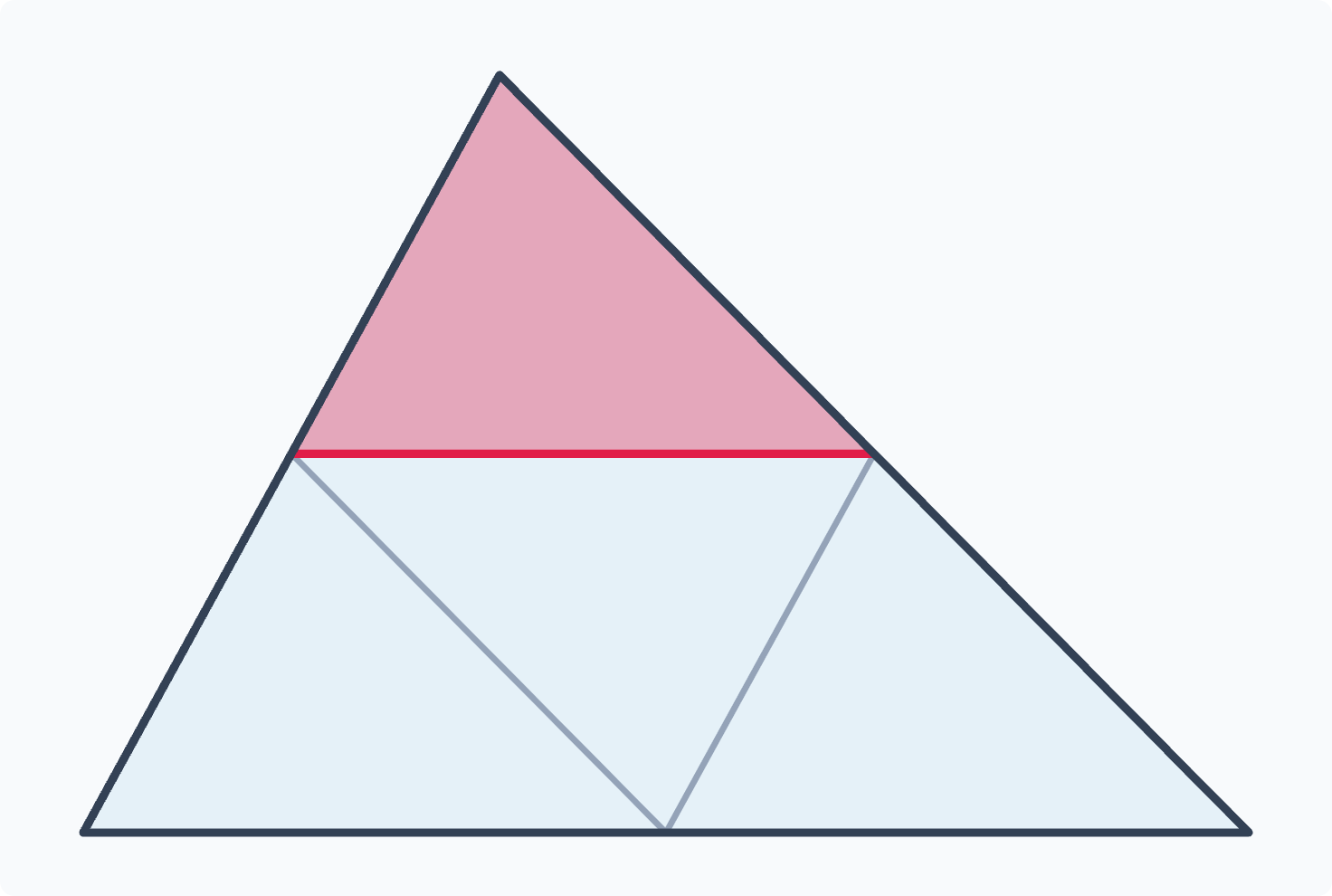
Similar with side ratio a : b:  perimeters, heights, medians, r, R → a : b;  areas → a² : b²
Tests: AA, SSS (sides in one ratio), SAS (two sides in ratio, equal angle between)
DE ∥ BC  ⇒  △ADE ~ △ABC  and  AD/DB = AE/EC
Same height (not similar):  area ratio = base ratio
Shortcut: Drop the altitude from the right angle to the hypotenuse. All three triangles are similar, so altitude² = product of the two hypotenuse pieces, and altitude = (product of legs) ÷ hypotenuse.
Mid-points, bisectors and medians: four theorems
Mid-point theorem:  D, E mid-points of AB, AC  ⇒  DE ∥ BC and DE = ½ BC
Basic proportionality:  DE ∥ BC  ⇔  AD/DB = AE/EC
Apollonius (D mid-point of BC):  AB² + AC² = 2(AD² + BD²)
Angle bisector from A meets BC at D:  BD/DC = AB/AC = c/b
Its length:  AD² = AB × AC − BD × DC
Exterior bisector at A meets BC extended at E:  BE/EC = AB/AC
The four centres
| Centre | Meeting point of | Key fact | Acute | Right | Obtuse |
|---|---|---|---|---|---|
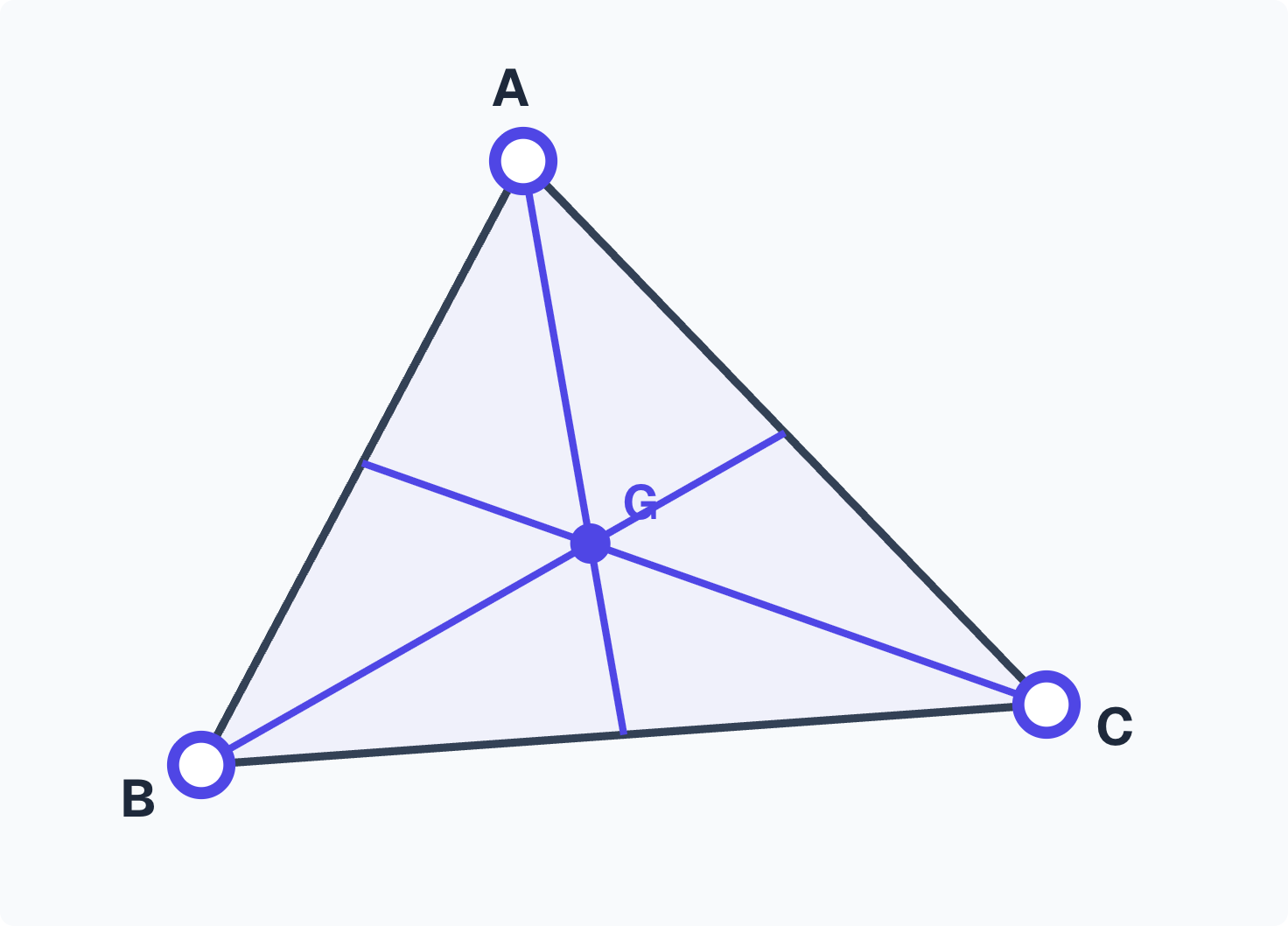
| Centroid G | medians | cuts each median 2 : 1 from the vertex; G = average of the vertices | inside | inside | inside |
| Incentre I | angle bisectors | equally far (r) from all three sides; ∠BIC = 90° + A/2 | inside | inside | inside |
| Circumcentre O | perpendicular bisectors of the sides | equally far (R) from all three vertices; ∠BOC = 2A when A is acute | inside | midpoint of the hypotenuse | outside |
| Orthocentre H | altitudes | ∠BHC = 180° − A in an acute triangle | inside | at the right-angle vertex | outside |
In an equilateral triangle all four coincide. In an isosceles triangle they all lie on the axis of symmetry.
Shortcut: O, G and H always lie on one straight line, with G between them and OG : GH = 1 : 2. The incentre joins that line only when the triangle is isosceles.
Centroid G = ((x₁ + x₂ + x₃)/3, (y₁ + y₂ + y₃)/3); divides each median 2 : 1
Inradius r = Area / s       Circumradius R = abc / (4 × Area)
Right triangle:  R = hypotenuse / 2,  r = (a + b − c) / 2
Equilateral side a:  R = a/√3,  r = a/(2√3),  R = 2r
Median: mₐ² = (2b² + 2c² − a²) / 4
Formulas stick when you use them
The Lines, Angles and Triangles lesson has worked problems and quick checks for every formula here. Free to start.
Start free