Circles and Polygons formulas
At a glance
Chord: r² = d² + (c/2)²
∠ at centre = 2 × ∠ at circumference;  semicircle → 90°
Same segment: equal angles;  cyclic quad: opposite ∠s = 180°
Tangent ⟂ radius;  PT = PT′ = √(d² − r²)
Common tangents: direct √(d² − (r₁ − r₂)²), transverse √(d² − (r₁ + r₂)²)
Apart 4, touching outside 3, cutting 2, touching inside 1, inside 0
PA × PB = PC × PD;  PT² = PA × PB;  tangent-chord ∠ = alternate segment ∠
Arc = θ/360 × 2πr;  sector = θ/360 × πr²
Interior sum = (n − 2) × 180°;  exterior = 360°/n
Diagonals = n(n − 3)/2
Rhombus, kite ½d₁d₂;  trapezium ½(a + b)h;  parallelogram bh
Cyclic quad: √((s − a)(s − b)(s − c)(s − d))
Regular hexagon: (3√3/2)a², diagonals 2a and a√3
Chords and the radius
OM ⟂ AB  ⟺  AM = MB
r² = d² + (c/2)²     (c = chord, d = distance from O)
Angle at the centre is twice the angle at the circumference
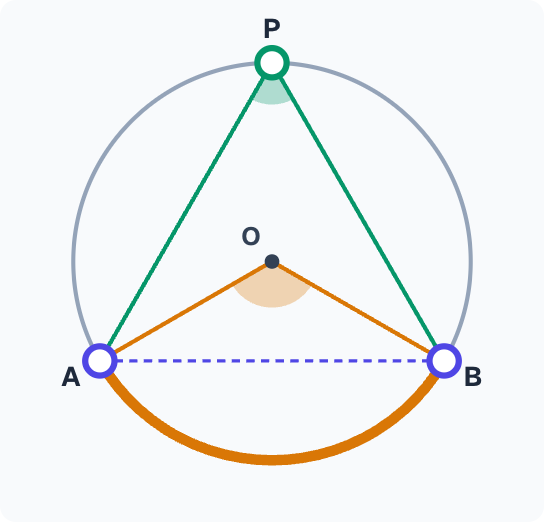
∠AOB = 2 × ∠APB   (same arc AB)
Angle in a semicircle = 90°
Shortcut: The converse is just as useful: in any right triangle, the hypotenuse is a diameter of its circumcircle. Circumradius = hypotenuse / 2.
Same segment and cyclic quadrilaterals
Same segment:  ∠APB = ∠AQB
Cyclic quadrilateral:  ∠A + ∠C = ∠B + ∠D = 180°
Exterior angle = interior opposite angle
Shortcut: Extend one side of a cyclic quadrilateral. The exterior angle you get equals the interior angle at the opposite corner, with no working needed.
Tangents
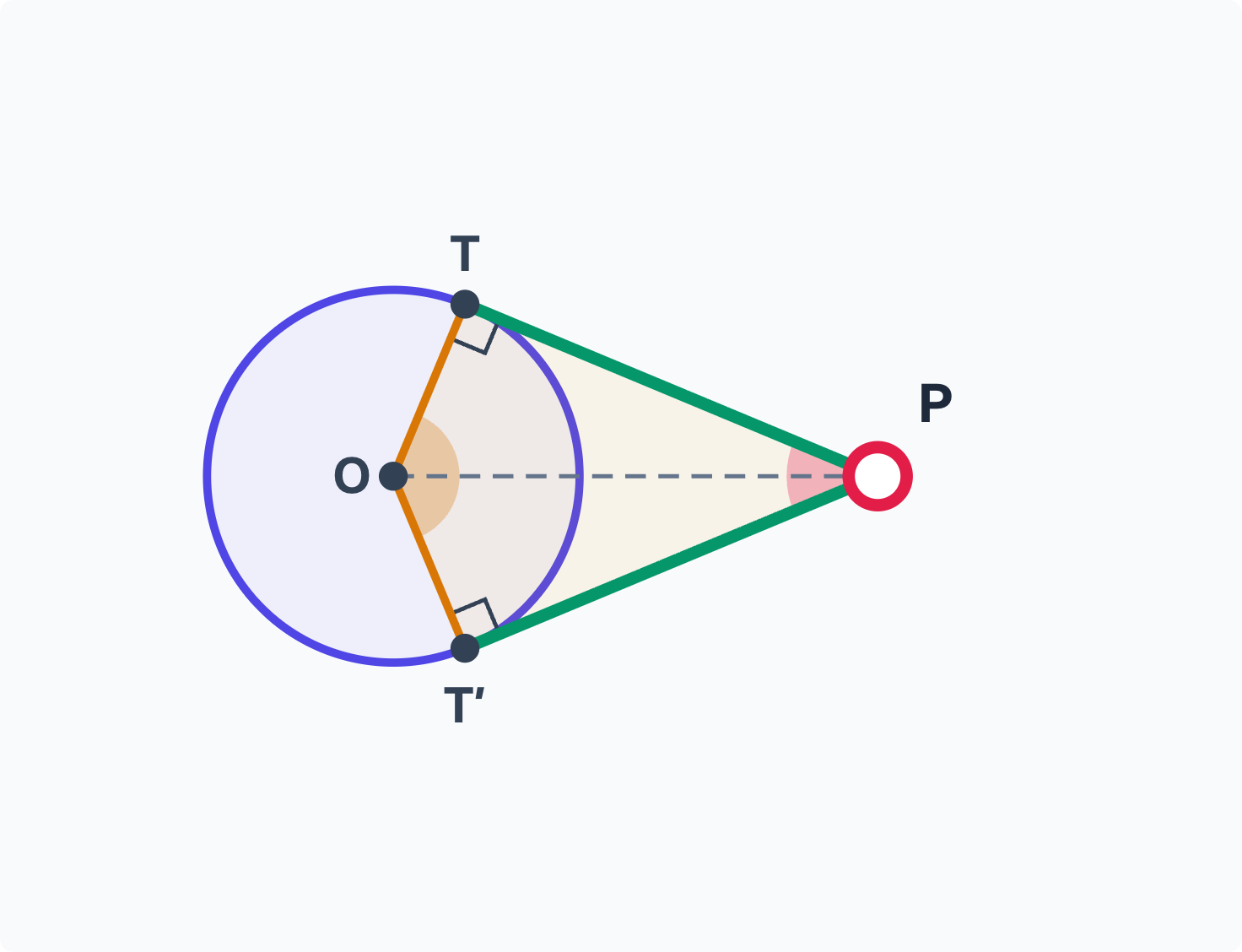
Tangent ⟂ radius at the point of contact
PT = PT′ = √(d² − r²)
∠TPT′ + ∠TOT′ = 180°
direct (both circles on the same side):   √(d² − (r₁ − r₂)²)
transverse (crosses between them):        √(d² − (r₁ + r₂)²)
r₁ = 8, r₂ = 3, d = 13:  direct √(169 − 25) = 12,  transverse √(169 − 121) = 4√3
| Position | Distance between centres | Direct | Transverse | Total |
|---|---|---|---|---|
| one inside the other | d < r₁ − r₂ | 0 | 0 | 0 |
| touching inside | d = r₁ − r₂ | 1 | 0 | 1 |
| cutting at two points | r₁ − r₂ < d < r₁ + r₂ | 2 | 0 | 2 |
| touching outside | d = r₁ + r₂ | 2 | 1 | 3 |
| apart | d > r₁ + r₂ | 2 | 2 | 4 |
Concentric circles (d = 0) are the extreme case of one inside the other: no common tangent.
Secants, crossing chords and the alternate segment
Chords AB and CD cross at P inside:   PA × PB = PC × PD
Secants PAB and PCD from P outside:   PA × PB = PC × PD
Tangent PT and secant PAB:            PT² = PA × PB
Alternate segment:  ∠(tangent, chord AB) at A = angle AB makes at any point in the other segment
Shortcut: A tangent at A and the chord AB make 70°. Then every point C on the arc away from that angle sees AB at 70° too, so ∠ACB = 70°. It is the 'same segment' rule with the tangent standing in for a chord.
Sectors and arcs
Arc length = θ/360 × 2πr
Sector area = θ/360 × πr²  = ½ × arc × r
Sector perimeter = arc + 2r
Angles of a polygon
Sum of interior angles = (n − 2) × 180°
Regular: each exterior = 360°/n,  each interior = 180° − 360°/n
Shortcut: Work through the exterior angle. It is small and 360/n is easy. Interior 156° means exterior 24°, so n = 360/24 = 15.
Diagonals of a polygon
Diagonals = n(n − 3)/2 = nC2 − n
From one vertex: n − 3, making n − 2 triangles
| Sides n | Name | Angle sum | Each interior | Each exterior | Diagonals |
|---|---|---|---|---|---|
| 3 | triangle | 180° | 60° | 120° | 0 |
| 4 | square | 360° | 90° | 90° | 2 |
| 5 | pentagon | 540° | 108° | 72° | 5 |
| 6 | hexagon | 720° | 120° | 60° | 9 |
| 7 | heptagon | 900° | 128⁴⁄₇° | 51³⁄₇° | 14 |
| 8 | octagon | 1080° | 135° | 45° | 20 |
| 9 | nonagon | 1260° | 140° | 40° | 27 |
| 10 | decagon | 1440° | 144° | 36° | 35 |
| 12 | dodecagon | 1800° | 150° | 30° | 54 |
Area = 6 × (√3/4)a² = (3√3/2)a²
long diagonal (through the centre) = 2a;  short diagonal = a√3
circumradius = a;  inradius = (√3/2)a
Quadrilaterals and their areas
Parallelogram = base × height
Rhombus = ½ × d₁ × d₂,   side² = (d₁/2)² + (d₂/2)²
Trapezium = ½ × (a + b) × h
Square = side² = ½ × diagonal²
| Shape | Sides and angles | Diagonals | Area | Cyclic? |
|---|---|---|---|---|
| Parallelogram | opposite sides equal and parallel; opposite angles equal | bisect each other; d₁² + d₂² = 2(a² + b²) | base × height = ab sin θ | only if a rectangle |
| Rectangle | every angle 90° | bisect each other and are equal | l × b | always |
| Rhombus | all four sides equal | bisect each other at 90° | ½ d₁d₂ | only if a square |
| Square | all sides equal, every angle 90° | equal, and bisect each other at 90° | a² = ½ d² | always |
| Kite | two pairs of equal neighbouring sides | perpendicular; the axis bisects the other | ½ d₁d₂ | only if the angles between unequal sides are 90° |
| Trapezium | one pair of parallel sides a, b | equal only in an isosceles trapezium | ½ (a + b) × h | only if isosceles |
| Cyclic quadrilateral | opposite angles add to 180° | AC × BD = AB × CD + AD × BC (Ptolemy) | √((s − a)(s − b)(s − c)(s − d)) | yes, by definition |
s = (a + b + c + d)/2. The cyclic area formula (Brahmagupta) is Heron's formula with a fourth side.
Shortcut: Sides 7, 24, 15, 20 round a circle of diameter 25 (7-24-25 and 15-20-25 triangles on the diameter). s = 33, so area = √(26 × 9 × 18 × 13) = 234, which matches 84 + 150 from the two right triangles.
Formulas stick when you use them
The Circles and Polygons lesson has worked problems and quick checks for every formula here. Free to start.
Start free