Modern Maths
Set Theory and Venn Diagrams formulas
At a glance
n(A ∪ B) = n(A) + n(B) − n(A ∩ B)
Total = union + none
n(A∪B∪C) = ΣA − Σ(pairs) + n(A∩B∩C)
ΣA = E1 + 2E2 + 3E3     union = E1 + E2 + E3
Subsets of an n-set: 2ⁿ (proper 2ⁿ − 1)   (A ∪ B)′ = A′ ∩ B′
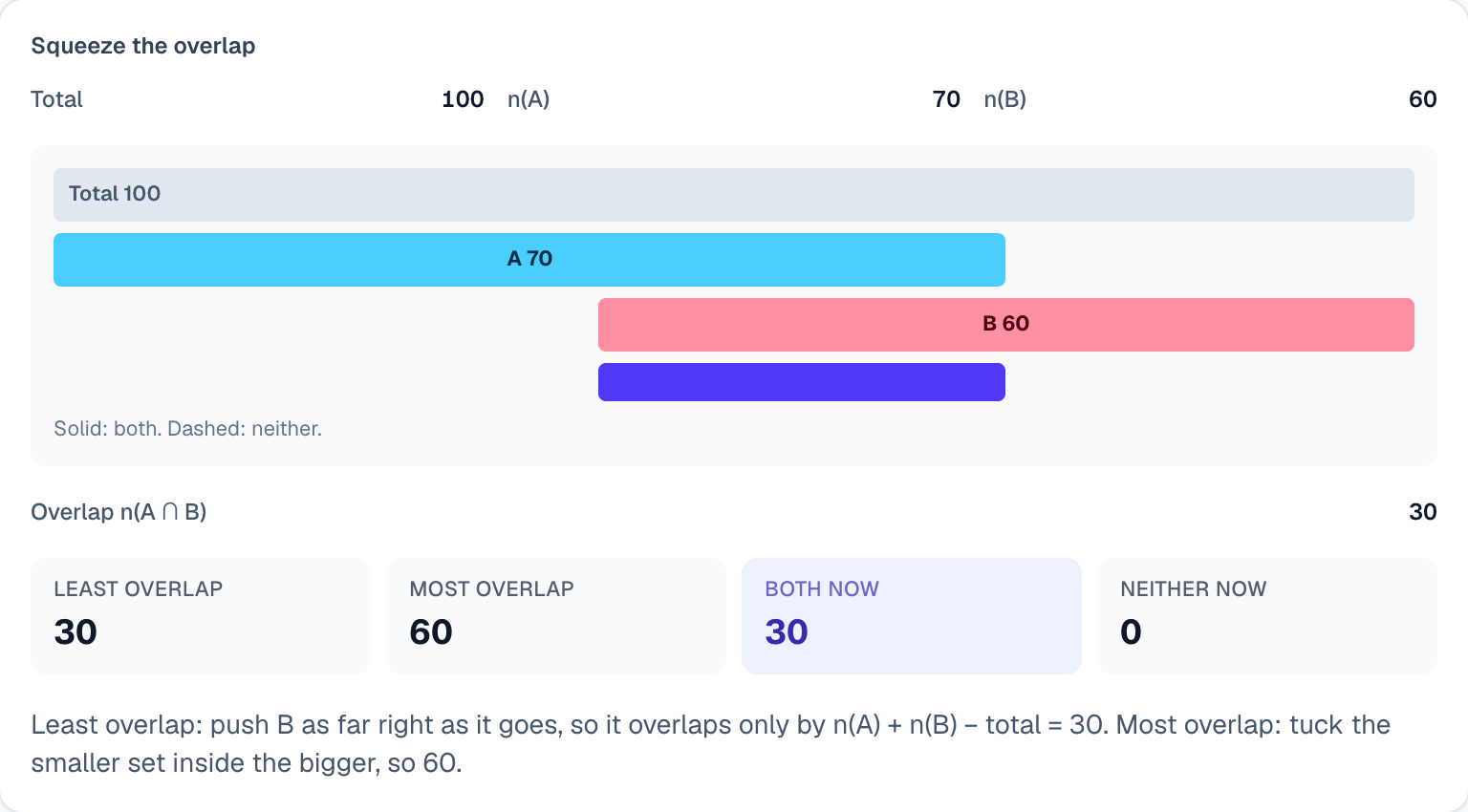
Two sets: both ∈ [max(0, a+b−T), min(a, b)]
Two sets: neither ∈ [max(0, T−a−b), T − max(a, b)]
Three sets (%): all three ≥ a + b + c − 200
Union and intersection
Only A = n(A − B) = n(A) − n(A ∩ B)
Or  → union ∪        And → intersection ∩
Not in A (complement):  n(A′) = total − n(A)
De Morgan:  (A ∪ B)′ = A′ ∩ B′,   (A ∩ B)′ = A′ ∪ B′
A set with n elements has 2ⁿ subsets, 2ⁿ − 1 of them proper (or non-empty)
The two-set formula
n(A ∪ B) = n(A) + n(B) − n(A ∩ B)
Shortcut: For 'divisible by a or b' up to N: count multiples of a, add multiples of b, subtract multiples of their LCM.
The 'none' region
Total = n(A ∪ B) + neither
Exactly one = n(A ∪ B) − n(A ∩ B)
Three sets
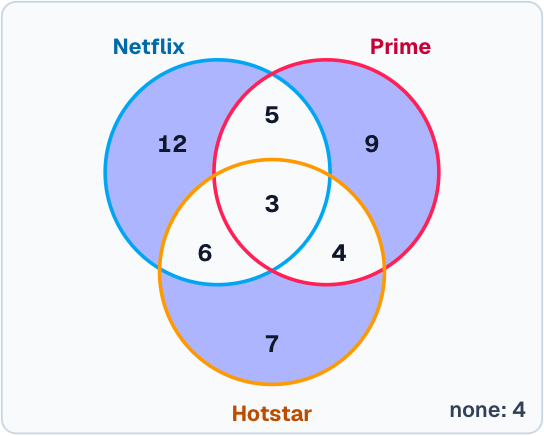
n(A ∪ B ∪ C) = n(A) + n(B) + n(C)
             − n(A∩B) − n(B∩C) − n(C∩A)
             + n(A∩B∩C)
Exactly one, two or three
n(A) + n(B) + n(C) = E1 + 2·E2 + 3·E3
n(A ∪ B ∪ C)       = E1 + E2 + E3
Total              = E1 + E2 + E3 + none
Shortcut: Sum of sets − union = E2 + 2·E3. Often this gives the missing piece in one line.
Least and greatest overlap
| Region | Least | Most | T = 100, a = 70, b = 60 |
|---|---|---|---|
| Both | max(0, a + b − T) | min(a, b) | 30 to 60 |
| Neither | max(0, T − a − b) | T − max(a, b) | 0 to 30 |
| Union (at least one) | max(a, b) | min(T, a + b) | 70 to 100 |
| Only A | max(0, a − b) | min(a, T − b) | 10 to 40 |
Most overlap: the smaller set sits inside the bigger. Least overlap: push them apart until the total runs out.
Least overlap of three sets
Least in all three = max(0, a + b + c − 2 × 100)   (percents)
Most in all three  = min(a, b, c)
Shortcut: For two sets it is a + b − 100. For three it is a + b + c − 200. Each extra set subtracts another 100.
Formulas stick when you use them
The Set Theory and Venn Diagrams lesson has worked problems and quick checks for every formula here. Free to start.
Start free