Modern Maths
Probability formulas
At a glance
P(E) = favourable / total
P(at least one) = 1 − P(none)
Independent: P(A and B) = P(A) P(B)
P(A or B) = P(A) + P(B) − P(A and B)
P(A | B) = P(A and B) / P(B)
E = Σ x·p        Odds a : b ⇔ P = a/(a+b)
Two dice: sum s in (s−1) or (13−s) ways
Exactly r of n: nCr pʳ(1 − p)ⁿ⁻ʳ     Bayes: P(A|B) = P(A) P(B|A) / P(B)
| The question says | Use |
|---|---|
| A and B, independent | P(A) × P(B) |
| A and B, the first changes the second | P(A) × P(B | A) |
| A or B, cannot both happen | P(A) + P(B) |
| A or B, in general | P(A) + P(B) − P(A and B) |
| not A | 1 − P(A) |
| at least one | 1 − P(none) |
| A, given that B happened | P(A and B) / P(B) |
| exactly r successes in n tries | nCr pʳ(1 − p)ⁿ⁻ʳ |
| odds in favour a : b | P = a/(a + b) |
| average result per play | E = Σ x·p |
Favourable over total
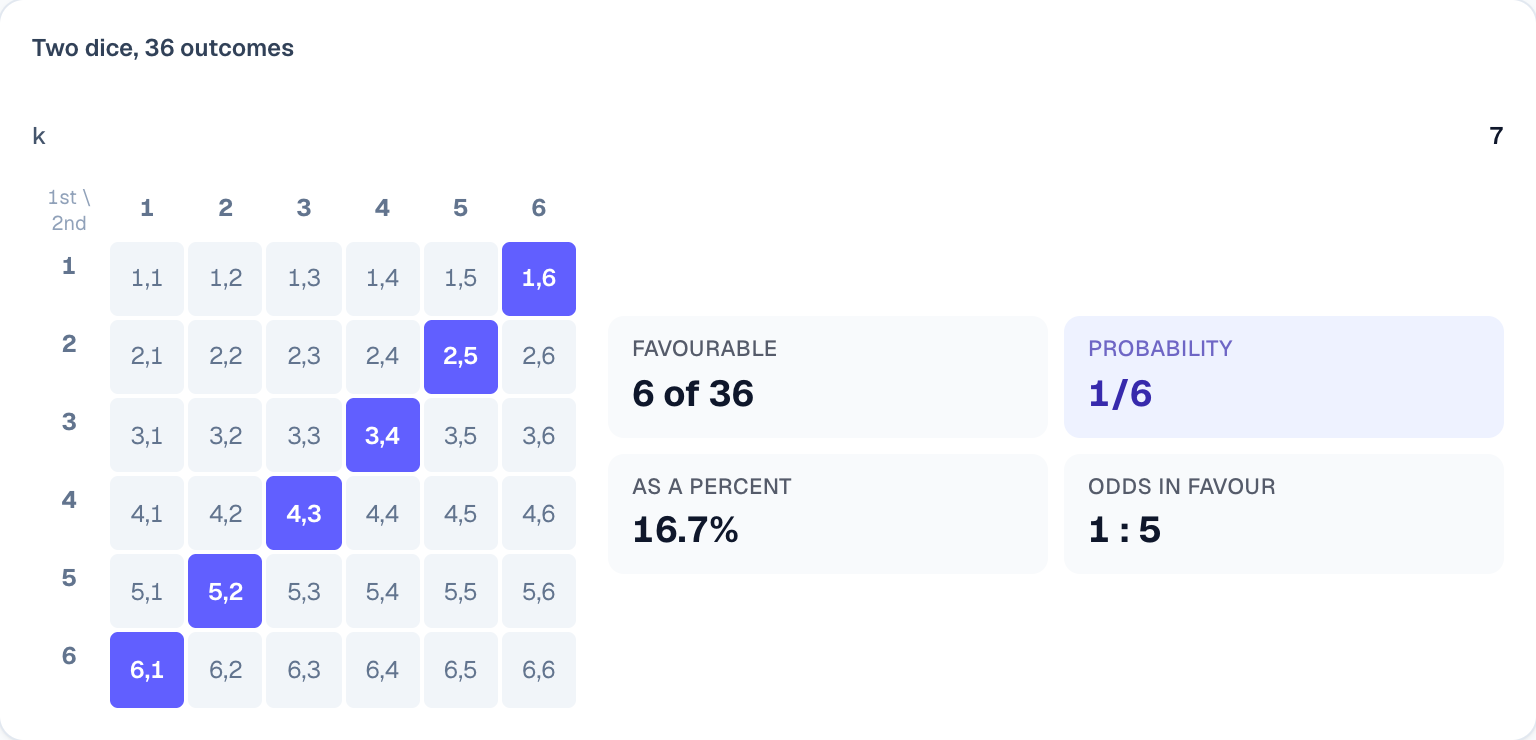
P(E) = favourable / total
0 ≤ P(E) ≤ 1      P(not E) = 1 − P(E)
Shortcut: Ways to make a sum s with two dice: s − 1 for s ≤ 7, and 13 − s for s ≥ 7. Sum 9: 13 − 9 = 4 ways.
'At least one': use the complement
P(at least one) = 1 − P(none)
And multiplies, or adds
Independent:  P(A and B) = P(A) × P(B)
Always:       P(A or B) = P(A) + P(B) − P(A and B)
Exclusive:    P(A or B) = P(A) + P(B)
Shortcut: 'The problem gets solved' means at least one person solves it. Multiply everyone's chance of failing, and subtract from 1.
Trees and conditional probability
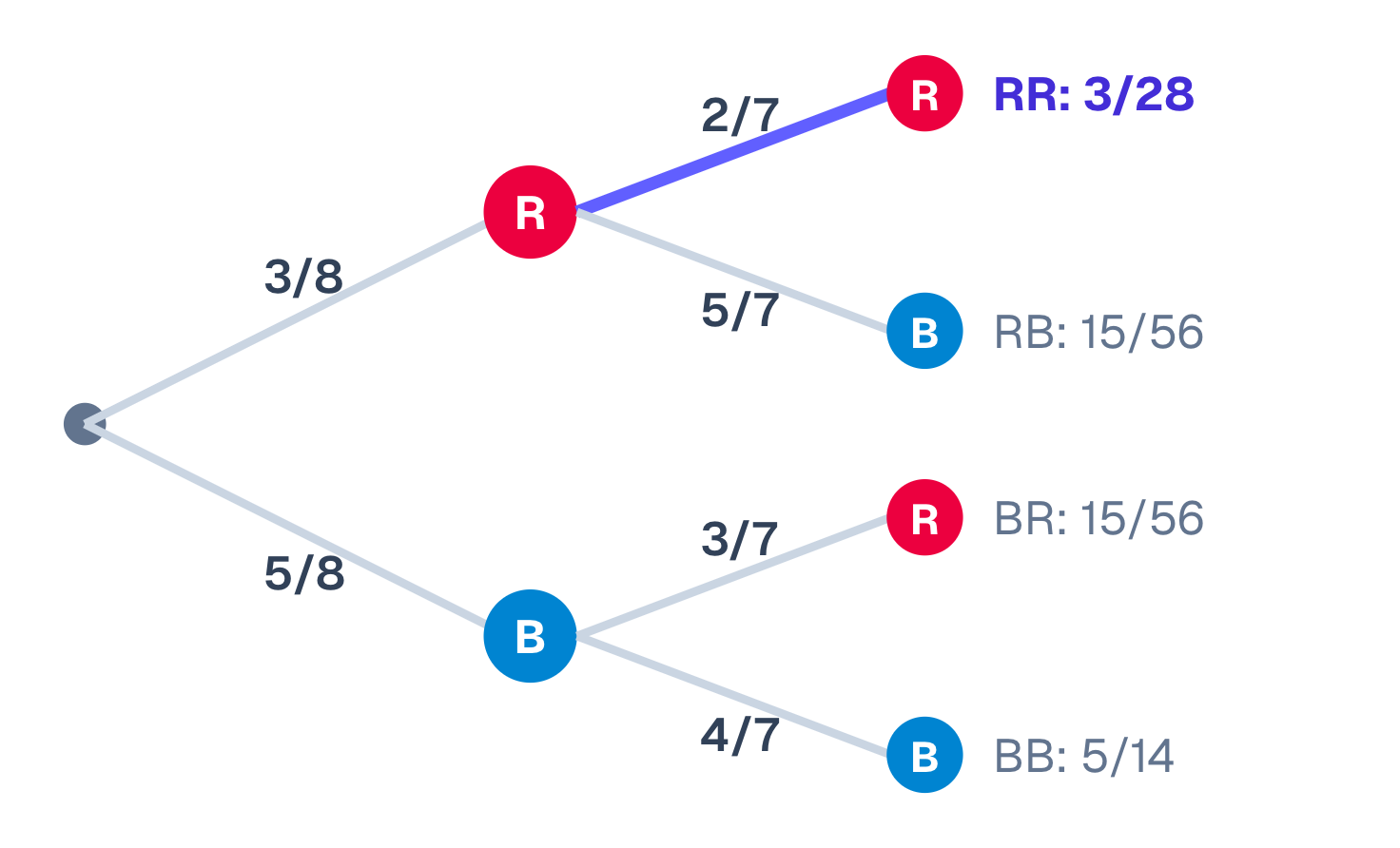
P(A and B) = P(A) × P(B | A)
P(A | B) = P(A and B) / P(B)
A, B independent  ⇔  P(A | B) = P(A)  ⇔  P(A and B) = P(A) × P(B)
Total probability:  P(B) = P(A) P(B | A) + P(not A) P(B | not A)
Bayes:  P(A | B) = P(A) P(B | A) / P(B)
Shortcut: Bag 1 has 3 red and 1 blue; bag 2 has 1 red and 3 blue. Toss a coin to pick a bag, then draw: it is red. P(bag 1 | red) = (½ × ¾) / (½ × ¾ + ½ × ¼) = ¾. The path you want, over all the paths that give what you saw.
Shortcut: Without replacement, the second ball is red with the same chance as the first: 3/8 here. Check it with 'Second is red'.
Repeated trials: exactly r successes
P(exactly r successes in n tries) = nCr × pʳ × (1 − p)ⁿ⁻ʳ
P(at least r) = add the 'exactly' terms from r up to n  (or 1 − the terms below r)
fair coin:  P(exactly k heads in n tosses) = nCk / 2ⁿ
Expected value
E = x₁p₁ + x₂p₂ + … + xₙpₙ
Fair game: expected gain = 0
Odds
Odds in favour a : b  ⇔  P = a / (a + b)
Odds against a : b    ⇔  P = b / (a + b)
Formulas stick when you use them
The Probability lesson has worked problems and quick checks for every formula here. Free to start.
Start free