Algebra
Quadratic Equations formulas
At a glance
x = (−b ± √D) / 2a,   D = b² − 4ac
D < 0 none · D = 0 equal · D > 0: rational if D is a perfect square, else p ± √q
α + β = −b/a   αβ = c/a   (α − β)² = (α + β)² − 4αβ
roots α, β  →  x² − (α + β)x + αβ = 0
cubic ax³ + bx² + cx + d:  Σα = −b/a   Σαβ = c/a   αβγ = −d/a
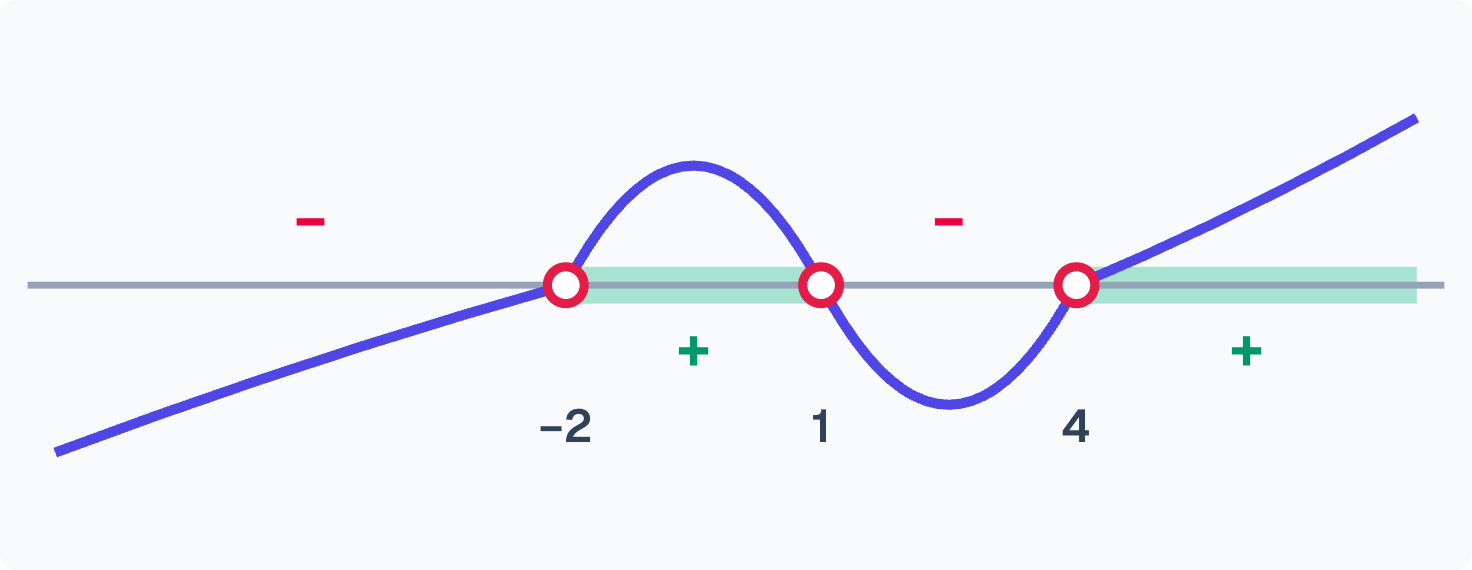
a > 0: negative between the roots, positive outside
vertex x = −b/2a, extreme value −D/4a
Roots by formula, and the picture behind them
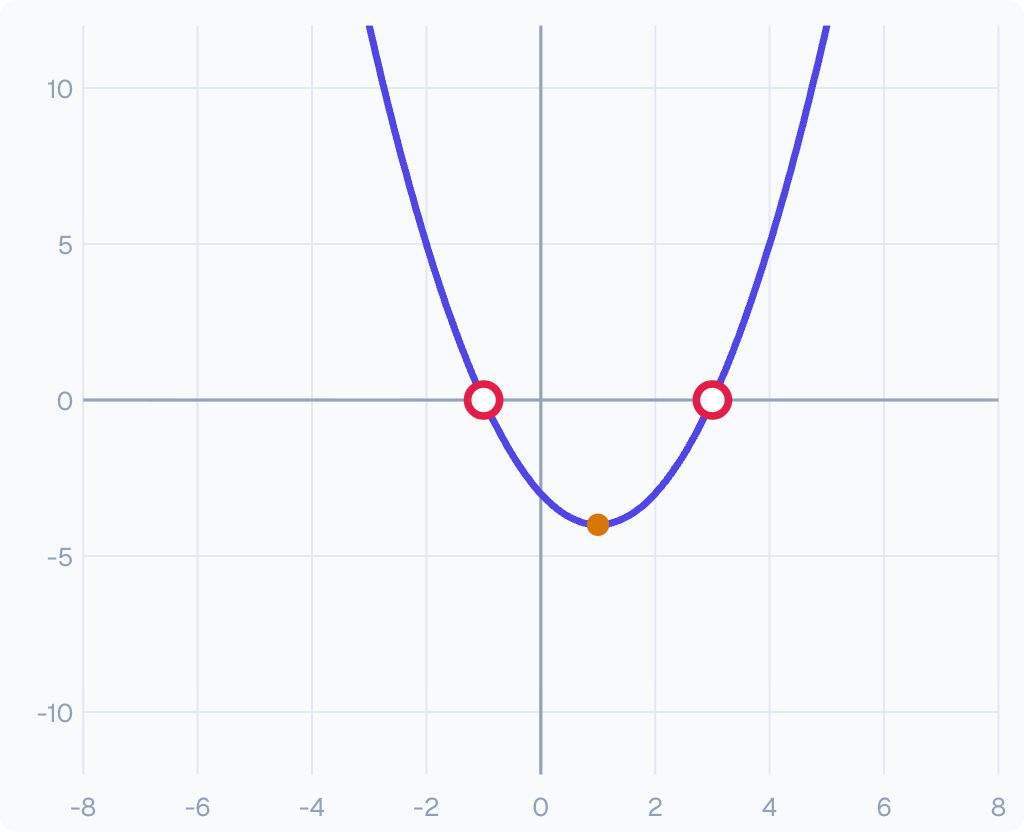
x = (−b ± √(b² − 4ac)) / 2a
The discriminant: nature of the roots
| D = b² − 4ac | Roots | Parabola | Example |
|---|---|---|---|
| D < 0 | No real roots (a complex pair) | Never meets the x-axis | x² + 2x + 5: D = −16 |
| D = 0 | Two equal real roots, x = −b/2a | Touches the x-axis at its vertex | x² − 6x + 9: D = 0, root 3 |
| D > 0, a perfect square | Two distinct rational roots | Crosses the x-axis twice | x² − 5x + 6: D = 1, roots 2, 3 |
| D > 0, not a perfect square | Two distinct irrational roots, a pair p ± √q | Crosses the x-axis twice | x² − 6x + 7: D = 8, roots 3 ± √2 |
The rational/irrational split needs rational a, b, c. With rational coefficients, irrational roots always come in conjugate pairs: if 3 + √2 is a root, so is 3 − √2.
Shortcut: If a and c have opposite signs, −4ac is positive, so D > 0 automatically. Real roots, no working needed.
Sum and product of roots
α + β = −b/a        αβ = c/a
α² + β² = s² − 2p
(α − β)² = s² − 4p
α³ + β³ = s³ − 3ps
1/α + 1/β = s/p
Forming an equation from its roots
roots 1/α, 1/β    →  cx² + bx + a = 0
roots −α, −β      →  ax² − bx + c = 0
roots kα, kβ      →  ax² + kbx + k²c = 0
roots α + k, β + k →  put (x − k) in place of x
Cubics and quartics: the same pattern
ax³ + bx² + cx + d = 0:   α + β + γ = −b/a    αβ + βγ + γα = c/a    αβγ = −d/a
ax⁴ + bx³ + cx² + dx + e = 0:   Σα = −b/a   Σαβ = c/a   Σαβγ = −d/a   αβγδ = e/a
α² + β² + γ² = (Σα)² − 2Σαβ        1/α + 1/β + 1/γ = Σαβ / αβγ
Shortcut: If the roots are in AP, call them a − d, a, a + d: their sum is 3a, so the middle root falls out of −b/a at once. In GP, call them a/r, a, ar: their product is a³, so the middle root comes from −d/a.
Sign of a quadratic: the wavy curve
Maximum and minimum at the vertex
vertex at x = −b/2a
extreme value = c − b²/4a = −D/4a
complete the square: x² − 8x + 21 = (x − 4)² + 5 ≥ 5
Shortcut: For a product of two brackets, the vertex is the average of the roots. No differentiation, no completing the square.
Formulas stick when you use them
The Quadratic Equations lesson has worked problems and quick checks for every formula here. Free to start.
Start free