Linear Equations and Inequalities formulas
At a glance
a₁/a₂ ≠ b₁/b₂ → one solution;  = b-ratio ≠ c-ratio → none;  all equal → infinite
ax + by = c in integers: needs gcd(a, b) | c; step x by b, y by a
× or ÷ by a negative → flip the inequality
|x − a| = distance from x to a
|x − a| < r ↔ a − r < x < a + r      |x − a| > r ↔ outside
Σ|x − pᵢ| is least at the median of the pᵢ
AM ≥ GM ≥ HM;  GM² = AM × HM;  a + b fixed → aᵐbⁿ greatest at a/m = b/n
|x + y| ≤ |x| + |y|    |x − y| ≥ ||x| − |y||    (a + x)/(b + x) moves a/b towards 1
From words to equations
Shortcut: In an MCQ, plug the options back in. For ages, the option where both conditions hold is the answer, often in under 30 seconds.
Two equations, two lines
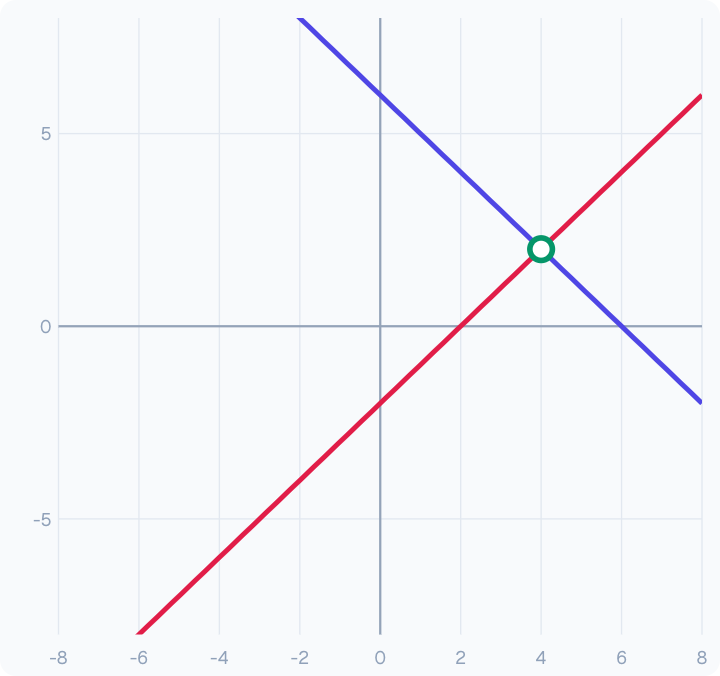
x + y = 6
x − y = 2
add:  2x = 8  →  x = 4,  y = 2
Shortcut: When the equations are ax + by = p and bx + ay = q, add them to get x + y and subtract to get x − y. Two lines of working.
One, none or infinitely many
a₁/a₂ ≠ b₁/b₂              →  one solution
a₁/a₂ = b₁/b₂ ≠ c₁/c₂      →  no solution (parallel)
a₁/a₂ = b₁/b₂ = c₁/c₂      →  infinitely many (same line)
Whole-number solutions of ax + by = c
Shortcut: Once you have one solution of ax + by = c (a, b with no common factor), the next comes from adding b to x and taking a off y. So the solutions are evenly spaced.
Modulus as distance
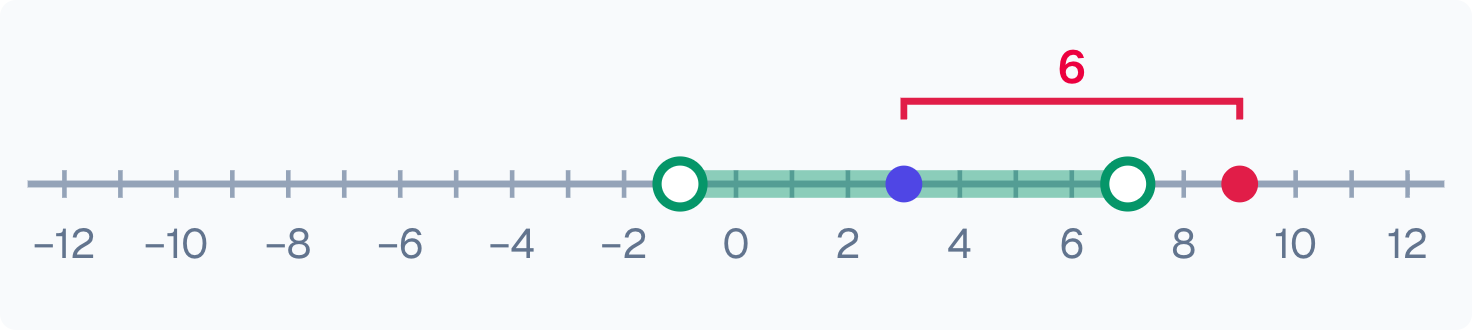
|x − a| = r   →   x = a − r  or  x = a + r
|x − a| < r   →   a − r < x < a + r
|x − a| > r   →   x < a − r  or  x > a + r
|x| < r  ↔  −r < x < r
Sums of distances
Shortcut: |x − p| + |x − q| + |x − r| + … is smallest when x is the median of p, q, r, …. With an even count, any x between the two middle points works.
Means and inequalities
AM ≥ GM ≥ HM,   with equality only when all the numbers are equal
two numbers:  AM = (a + b)/2   GM = √(ab)   HM = 2ab/(a + b)   GM² = AM × HM
fixed sum  →  the product is greatest when the parts are equal
fixed product  →  the sum is least when the parts are equal
a + b fixed  →  aᵐbⁿ is greatest when a/m = b/n
Shortcut: To make aᵐbⁿ as large as possible with a + b = k, give a the share m/(m + n) of k and b the share n/(m + n). It is AM ≥ GM applied to m equal pieces a/m and n equal pieces b/n.
|x + y| ≤ |x| + |y|      (equal exactly when xy ≥ 0)
|x − y| ≥ ||x| − |y||    (equal exactly when xy ≥ 0)
a < b  →  (a + x)/(b + x) > a/b     (rises towards 1)
a > b  →  (a + x)/(b + x) < a/b     (falls towards 1)
a = b  →  no change
Shortcut: Comparing 1001/1002 with 1002/1003? The second is the first with 1 added to the top and bottom. The fraction is below 1, so it rises: 1002/1003 is bigger.
Formulas stick when you use them
The Linear Equations and Inequalities lesson has worked problems and quick checks for every formula here. Free to start.
Start free