Progressions and Series formulas
At a glance
AP: tₙ = a + (n − 1)d     Sₙ = n/2 × (a + l) = average × count
GP: tₙ = a·rⁿ⁻¹     Sₙ = a(rⁿ − 1)/(r − 1)     S∞ = a/(1 − r), |r| < 1
AM ≥ GM ≥ HM     GM² = AM × HM     middle term: AP 2b = a + c,  GP b² = ac,  HP b = 2ac/(a + c)
Σk = n(n + 1)/2   Σk² = n(n + 1)(2n + 1)/6   Σk³ = (Σk)²
1/(k(k + d)) = (1/d)(1/k − 1/(k + d))
Arithmetic progressions: equal steps
nth term:  tₙ = a + (n − 1)d
step from any two terms:  d = (tₘ − tₖ) / (m − k)
number of terms from a to l:  n = (l − a)/d + 1
Shortcut: Three terms in AP: a − d, a, a + d (their sum is 3a, so a pops out at once). Four terms: a − 3d, a − d, a + d, a + 3d, with step 2d.
Sum of an AP: flip and add
Sₙ = n/2 × (a + l)
Sₙ = n/2 × [2a + (n − 1)d]
average of an AP = (first + last)/2 = middle term
Shortcut: Terms equally far from the two ends always add to the same total: t₁ + tₙ = t₂ + tₙ₋₁ = … And with an odd number of terms, the sum is simply n × the middle term.
Geometric progressions: equal ratios
nth term:  tₙ = a·rⁿ⁻¹
sum of n terms:  Sₙ = a(rⁿ − 1)/(r − 1),  r ≠ 1
if r = 1:  Sₙ = n·a
Shortcut: Three terms in GP: a/r, a, ar. Their product is a³, so a product of 216 tells you the middle term is 6. For any three consecutive terms, middle² = first × third.
Infinite GP: sums that stop growing
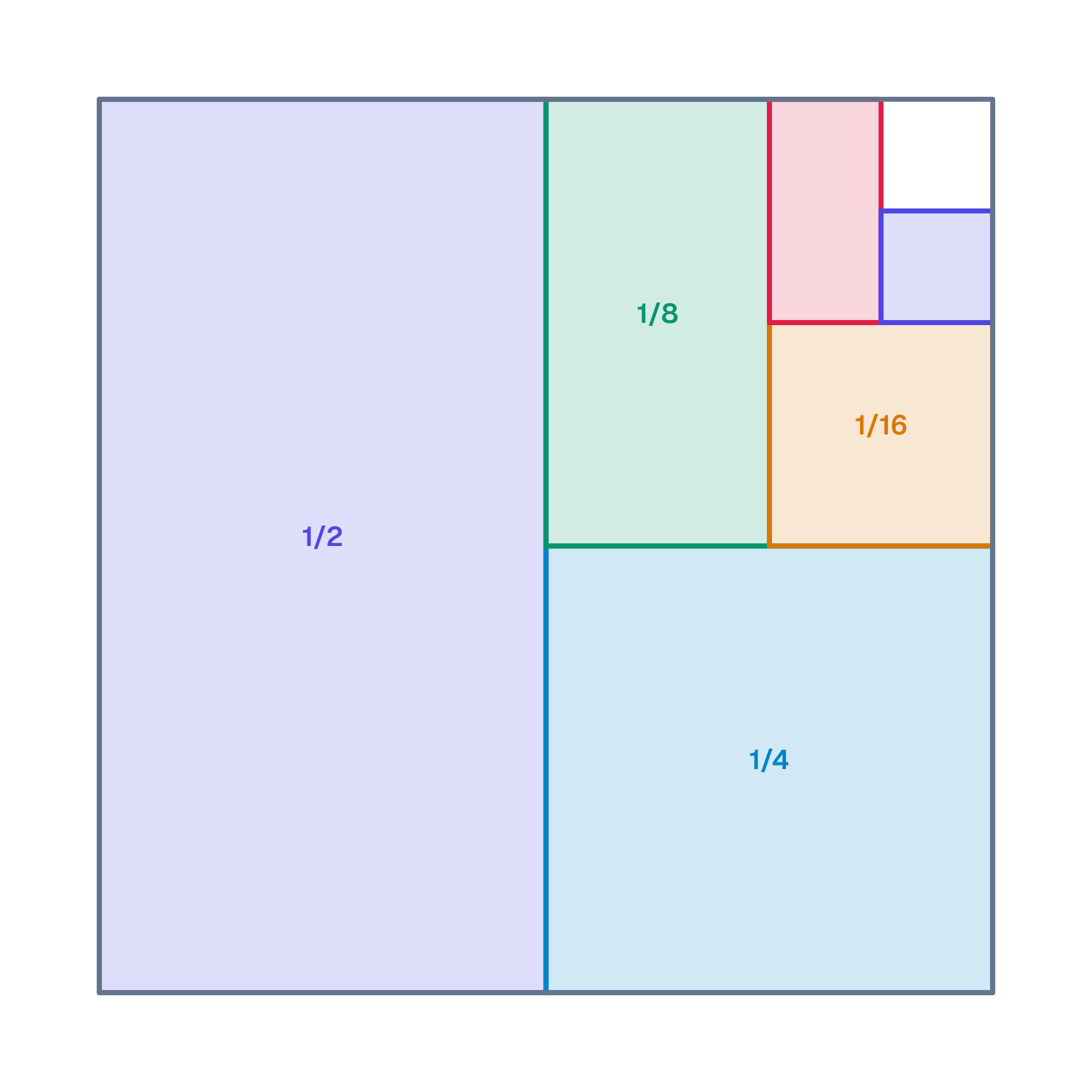
S∞ = a / (1 − r), only when −1 < r < 1
Shortcut: 0.363636… = 0.36 + 0.0036 + … = 0.36/(1 − 0.01) = 36/99 = 4/11.
AM, GM and HM
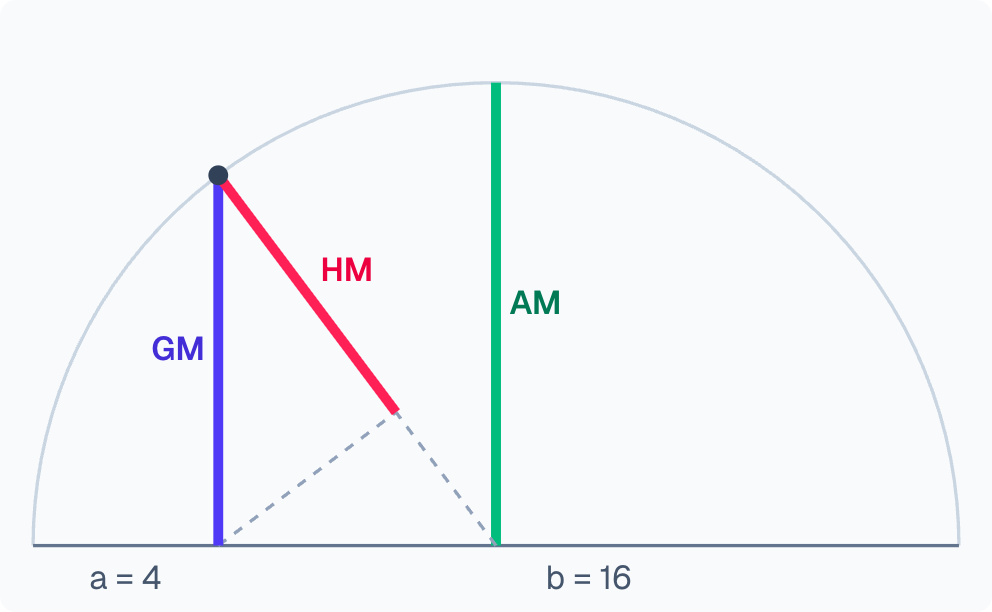
AM ≥ GM ≥ HM   (equal only when a = b)
GM² = AM × HM   (for two numbers)
4 and 16:  AM 10, GM 8, HM 6.4, and 10 × 6.4 = 64 = 8²
| Progression | a, b, c in it when | n means between a and b |
|---|---|---|
| AP | 2b = a + c | step d = (b − a)/(n + 1) |
| GP | b² = ac | ratio r = (b/a)^(1/(n + 1)) |
| HP (reciprocals in AP) | b = 2ac/(a + c) | insert APs between 1/a and 1/b, then flip |
An HP has no sum formula: turn it into an AP of reciprocals and work there.
Shortcut: Fixed sum: the product is largest when the parts are equal. Fixed product: the sum is smallest when the parts are equal. And x + 1/x ≥ 2 for every positive x.
Special sums: 1 + 2 + … + n, squares, cubes
1 + 2 + … + n = n(n + 1)/2
1² + 2² + … + n² = n(n + 1)(2n + 1)/6
1³ + 2³ + … + n³ = [n(n + 1)/2]²
1 + 3 + 5 + … (n odd numbers) = n²     2 + 4 + … + 2n = n(n + 1)
Telescoping and arithmetic-geometric series
1/(k(k + d)) = (1/d) × (1/k − 1/(k + d))
1/(1·2) + 1/(2·3) + … + 1/(n(n + 1)) = 1 − 1/(n + 1) = n/(n + 1)
Shortcut: 1/(√k + √(k + 1)) = √(k + 1) − √k. So the sum from k = 1 to 99 is √100 − √1 = 9.
Formulas stick when you use them
The Progressions and Series lesson has worked problems and quick checks for every formula here. Free to start.
Start free