Algebra
Binomial Theorem formulas
At a glance
(a + b)ⁿ = Σ nCr aⁿ⁻ʳ bʳ (r = 0 … n)     n + 1 terms     nCr = nC(n − r)
Tᵣ₊₁ = nCr aⁿ⁻ʳ bʳ     kth term: r = k − 1
xᵏ or constant term: power of x in Tᵣ₊₁ = k or 0; r must be whole, 0 ≤ r ≤ n
Middle: n even → T(n/2 + 1); n odd → two middle terms     largest nCr in the middle
Σ coefficients = f(1)     Σ nCr = 2ⁿ     odd places = even places = 2ⁿ⁻¹
Even powers: [f(1) + f(−1)]/2     odd powers: [f(1) − f(−1)]/2
(dm + 1)ⁿ leaves 1 ÷ d     (dm − 1)ⁿ leaves (−1)ⁿ     11ⁿ ends like 1 + 10n
(1 + x)ⁿ ≈ 1 + nx + n(n − 1)x²/2 for small x
Expanding (a + b)ⁿ: Pascal's triangle
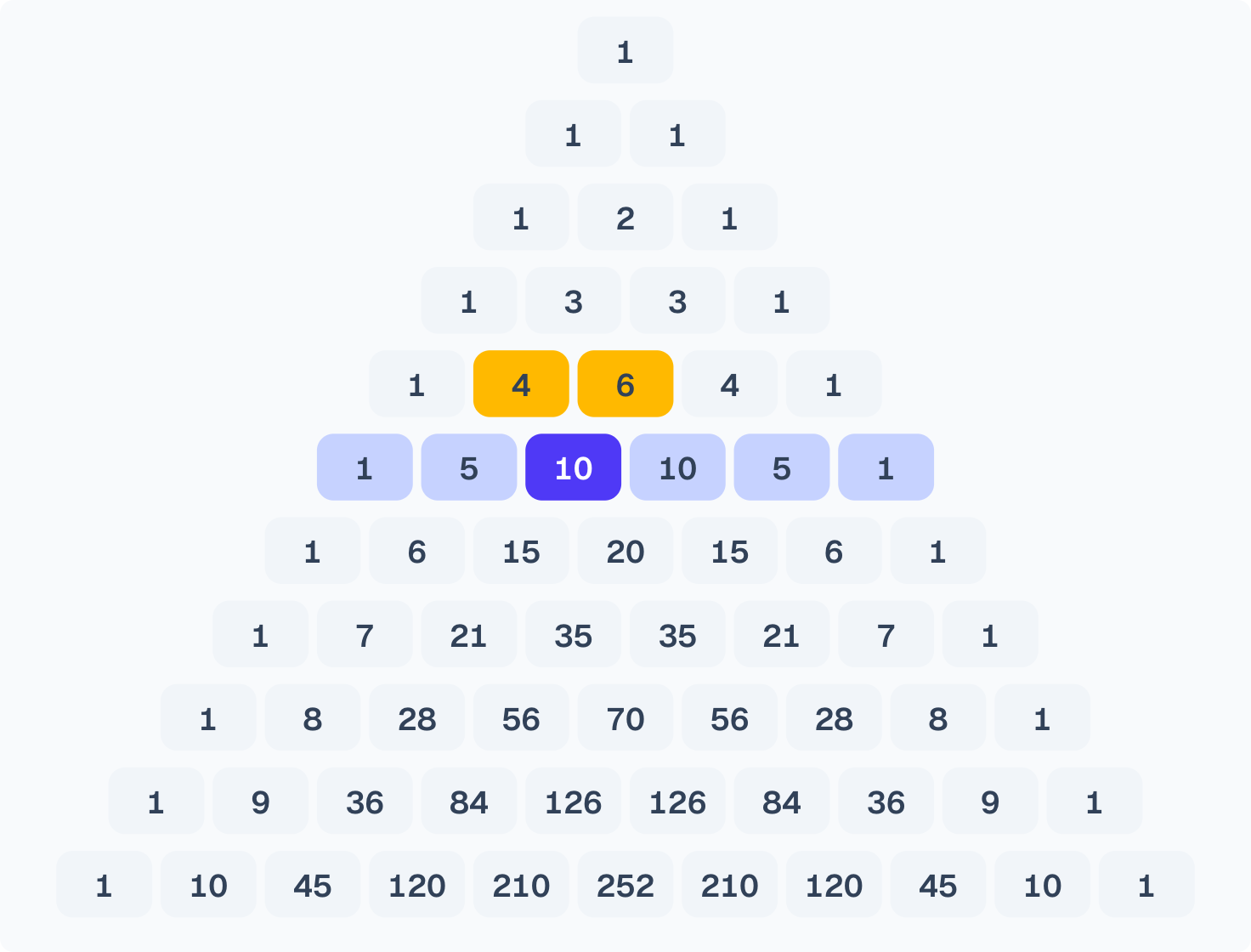
| n | Coefficients of (a + b)ⁿ | Terms | Sum = 2ⁿ |
|---|---|---|---|
| 0 | 1 | 1 | 1 |
| 1 | 1 1 | 2 | 2 |
| 2 | 1 2 1 | 3 | 4 |
| 3 | 1 3 3 1 | 4 | 8 |
| 4 | 1 4 6 4 1 | 5 | 16 |
| 5 | 1 5 10 10 5 1 | 6 | 32 |
| 6 | 1 6 15 20 15 6 1 | 7 | 64 |
Each row reads the same forwards and backwards, because nCr = nC(n − r).
(a + b)ⁿ = nC0 aⁿ + nC1 aⁿ⁻¹b + nC2 aⁿ⁻²b² + … + nCn bⁿ
number of terms = n + 1
in every term, power of a + power of b = n
nCr = (n − 1)C(r − 1) + (n − 1)Cr      nCr = nC(n − r)
The general term: build any term directly
Tᵣ₊₁ = nCr · aⁿ⁻ʳ · bʳ,   r = 0, 1, …, n
the kth term uses r = k − 1
Constant term, middle term and missing terms
power of x in Tᵣ₊₁ of (xᵖ + c/xᵠ)ⁿ:  p(n − r) − qr
constant term: set that power = 0;  xᵏ term: set it = k
middle term: n even → T(n/2 + 1);  n odd → T((n + 1)/2) and T((n + 3)/2)
largest binomial coefficient: the middle one(s), nC(n/2) for even n
Shortcut: Powers go n, n − 2, n − 4, … So a constant term exists only for even n, and then it is the middle term nC(n/2). For (x + 1/x)¹⁰ it is 10C5 = 252.
Sums of coefficients: put x = 1
sum of all coefficients of f(x) = f(1)
nC0 + nC1 + nC2 + … + nCn = 2ⁿ
nC0 + nC2 + nC4 + … = nC1 + nC3 + nC5 + … = 2ⁿ⁻¹
coefficients of even powers = [f(1) + f(−1)]/2;  odd powers = [f(1) − f(−1)]/2
Shortcut: A set of n things has nC0 + nC1 + … + nCn = 2ⁿ subsets, and 2ⁿ − 1 non-empty ones. Choosing at least one of 8 toppings: 2⁸ − 1 = 255 ways.
Remainders: one more than a multiple
(dm + 1)ⁿ leaves 1 when divided by d
(dm − 1)ⁿ leaves (−1)ⁿ: 1 if n even, d − 1 if n odd
(x + 1)ⁿ leaves 1 when divided by x
(1 + 10)ⁿ = 1 + 10n + (multiple of 100)
| Question | Rewrite | Remainder |
|---|---|---|
| 9ⁿ ÷ 8 | 9 = 8 + 1 | 1, always |
| 5ⁿ ÷ 6 | 5 = 6 − 1 | 1 (n even), 5 (n odd) |
| 2ⁿ ÷ 7 | 2³ = 8 = 7 + 1 | repeats 2, 4, 1 as n mod 3 = 1, 2, 0 |
| 2ⁿ ÷ 9 | 2³ = 8 = 9 − 1 | cycle of 6: 2, 4, 8, 7, 5, 1 |
| 7ⁿ ÷ 48 | 7² = 49 = 48 + 1 | 1 (n even), 7 (n odd) |
| 11ⁿ ÷ 100 | 11 = 10 + 1 | last two digits of 1 + 10n |
Approximation: (1 + x)ⁿ ≈ 1 + nx
(1 + x)ⁿ ≈ 1 + nx                     (x small)
(1 + x)ⁿ ≈ 1 + nx + n(n − 1)x²/2      (one more term for 3 decimals)
(1 − x)ⁿ ≈ 1 − nx
Shortcut: 1.02¹⁰ ≈ 1 + 0.2 + 45 × 0.0004 = 1.218 (true value 1.2190). 0.99⁵ ≈ 1 − 0.05 = 0.95 (true value 0.9510).
Formulas stick when you use them
The Binomial Theorem lesson has worked problems and quick checks for every formula here. Free to start.
Start free