Simple and Compound Interest formulas
At a glance
SI = PRT/100            A = P(1 + R/100)^T
k times a year: R/k per period, kT periods
CI − SI, 2 yr = PR²/100²    3 yr = PR²(300 + R)/100³
SI doubles in 100/R yr     CI doubles in ≈ 72/R yr
Loan = x/(1 + r) + x/(1 + r)²
Depreciation: P(1 − R/100)^n
CAGR = (F/I)^(1/n) − 1  <  simple annual rate = total % ÷ n
Simple interest: the same slice every year
SI = P × R × T / 100
Amount A = P + SI
Shortcut: SI for T years at R% is simply (R × T)% of the principal. 8% for 5 years is 40% of P; 12.5% for 4 years is 50% of P.
Compound interest: interest on interest
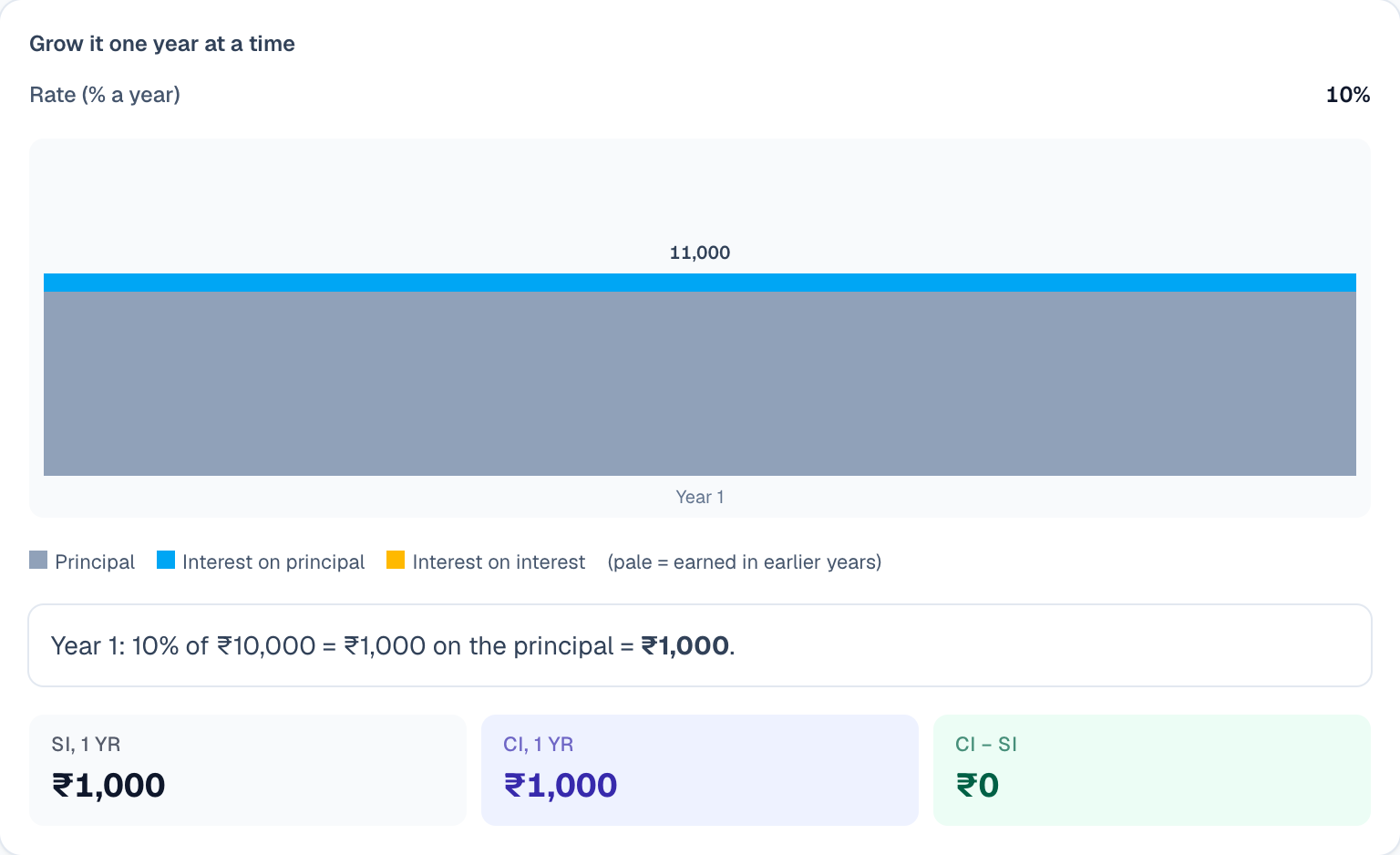
A = P × (1 + R/100)^T
CI = A − P
SI vs CI: a line against a curve
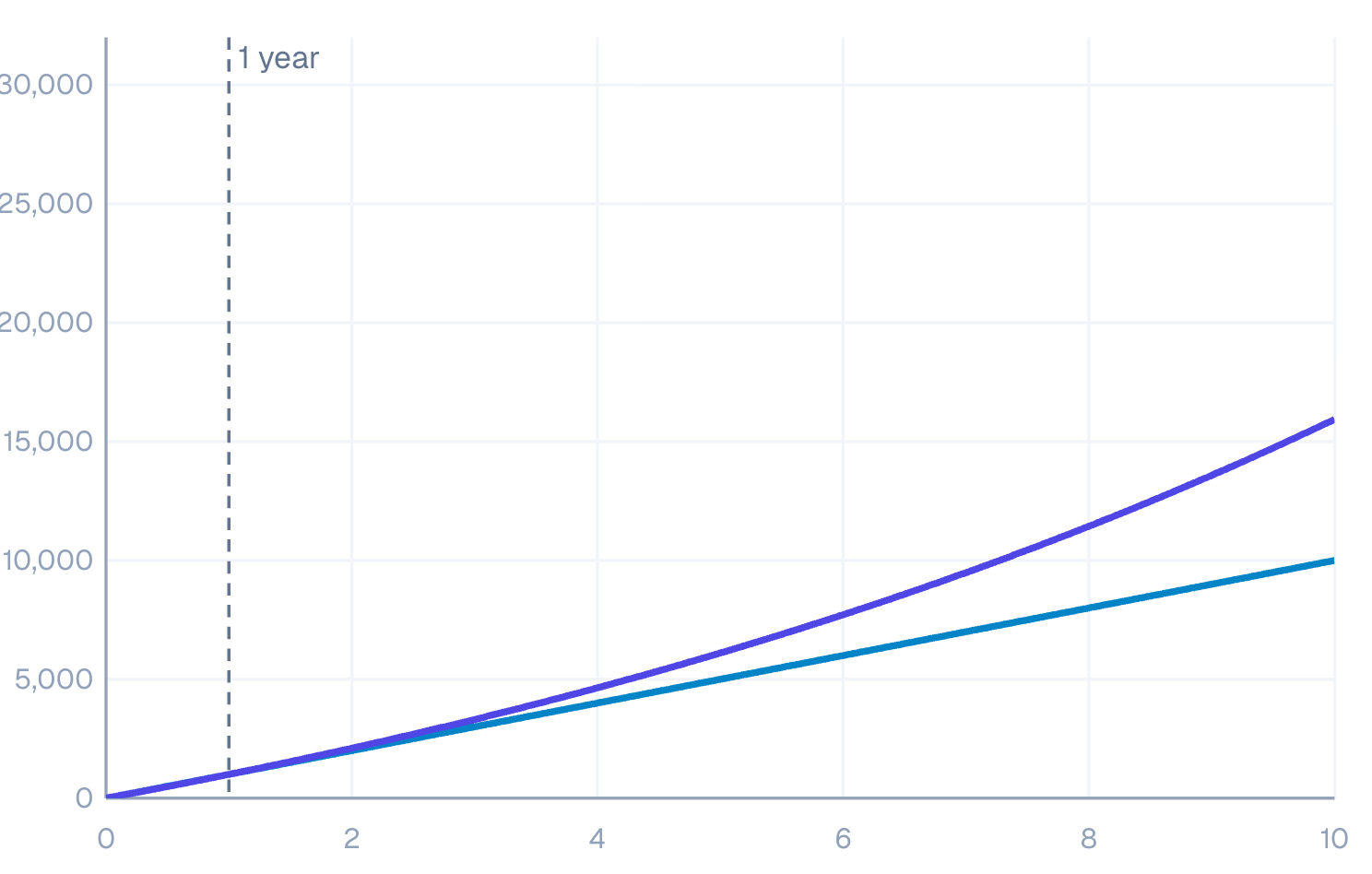
Shortcut: SI for 2 years tells you P × R. Then CI for 2 years = SI × (1 + R/200). At 10%, CI for 2 years is 1.05 × the SI.
Half-yearly and quarterly compounding
A = P × (1 + R/(100k))^(kT)
Half-yearly: R/2 per period, 2T periods
Quarterly: R/4 per period, 4T periods
Shortcut: 20% a year compounded half-yearly is 10% twice: 10 + 10 + 10×10/100 = 21% a year. It is the successive-change formula from Percentages.
CI − SI for 2 and 3 years
2 years:  CI − SI = P × (R/100)² = PR² / 100²
3 years:  CI − SI = PR²(300 + R) / 100³
Shortcut: The 2-year gap is just one year's SI earning interest for one year: CI − SI = (one year's SI) × R/100.
Doubling, tripling and the rule of 72
CI: doubling time ≈ 72 / R years (rule of 72)
SI: doubling time = 100 / R years
CI: x× in n years  →  x^k × in kn years
Equal instalments (in brief)
Loan = x/(1 + r) + x/(1 + r)² (r = R/100)
Population growth and depreciation
Growth:        P × (1 + R/100)^n
Depreciation:  P × (1 − R/100)^n
n years ago:   P / (1 + R/100)^n
Different rates: P × (1 + a/100)(1 + b/100)(1 + c/100)
Growth rates: absolute, average and CAGR
absolute growth = F − I        total growth % = (F − I) / I × 100
simple (average) annual growth = total growth % ÷ n
CAGR = (F / I)^(1/n) − 1
yearly rates a, b, c, …:  CAGR = [(1 + a)(1 + b)(1 + c)…]^(1/n) − 1
| Rate | 2 years | 3 years | 4 years | 5 years |
|---|---|---|---|---|
| 5% | 1.1025 | 1.158 | 1.216 | 1.276 |
| 10% | 1.21 | 1.331 | 1.464 | 1.611 |
| 15% | 1.3225 | 1.521 | 1.749 | 2.011 |
| 20% | 1.44 | 1.728 | 2.074 | 2.488 |
| 25% | 1.5625 | 1.953 | 2.441 | 3.052 |
Revenue up 1.75 times in 4 years? The 4-year column puts that at about 15% CAGR.
Shortcut: Find F/I, then find the row in the growth-factor table whose n-year factor is closest. For a doubling, use the rule of 72: doubling in n years means CAGR ≈ 72/n %. For small growth over a few years, CAGR is a little under the simple rate, so if the options are far apart, pick the one just below total growth ÷ n.
Formulas stick when you use them
The Simple and Compound Interest lesson has worked problems and quick checks for every formula here. Free to start.
Start free