Averages formulas
At a glance
Average = sum ÷ n = assumed + (sum of deviations) ÷ n
Joins: A + (x − A)/(n + 1)    Leaves: A − (x − A)/(n − 1)
Replace: change = (in − out) ÷ n
Weighted: (n₁a₁ + n₂a₂)/(n₁ + n₂);  distances in ratio n₂ : n₁
Equal distances: 2ab/(a + b)    Equal times: (a + b)/2
Equally spaced: average = (first + last)/2 = middle term
Ages: same group, t years on → average + t
The average is a balancing point
Average = sum of values ÷ number of values
Average = assumed value + (sum of deviations) ÷ n
Shortcut: Pick a round number near the middle. Add up only the small differences from it, divide by n, and correct your guess. No big totals.
Someone joins, someone leaves
Joins:  new average = A + (x − A) ÷ (n + 1)
Leaves: new average = A − (x − A) ÷ (n − 1)
Newcomer who raises the average by c:  x = A + (n + 1) × c
Shortcut: Work backwards. A newcomer who lifts the average of 24 by 1 brings his own share A, plus 1 for each of the 25 people now in the group: x = A + 25.
Replacement: one in, one out
Change in average = (incoming − outgoing) ÷ n
Incoming = outgoing + n × (change in average)
Weighted average: merging groups
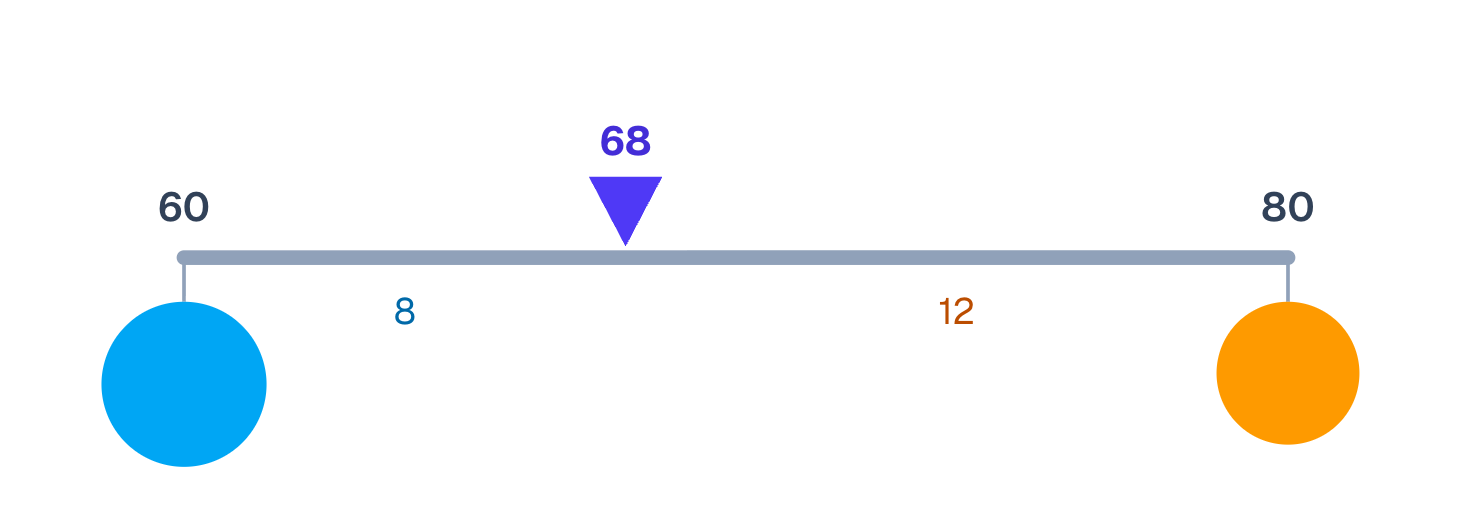
Combined = (n₁a₁ + n₂a₂) ÷ (n₁ + n₂)
(W − a₁) : (a₂ − W) = n₂ : n₁
Shortcut: Split the gap in the inverse ratio of the sizes. Averages 60 and 80, sizes 30 and 20: the gap of 20 splits 2 : 3, so W = 60 + 8 = 68.
Average speed is not the average of speeds
Average speed = total distance ÷ total time
Equal distances at a and b:  2ab ÷ (a + b)
Equal times at a and b:  (a + b) ÷ 2
Shortcut: Pick a distance that both speeds divide, like the LCM. For 12 and 18 km/h, take 36 km each way: 3 h + 2 h, so 72 ÷ 5 = 14.4 km/h.
Consecutive numbers: the middle term
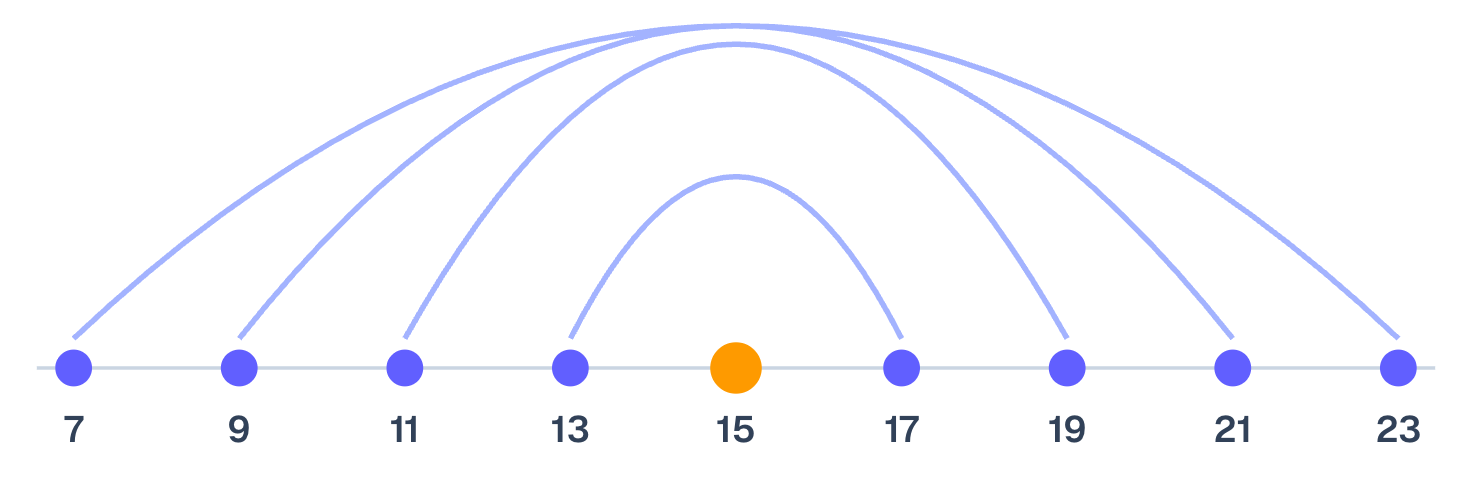
Average = (first + last) ÷ 2 = the middle term
Sum = count × average
Average of 1, 2, …, n = (n + 1) ÷ 2
Shortcut: The first n odd numbers average n, so they sum to n². The first n even numbers average n + 1, so they sum to n(n + 1).
Ages: everyone grows together
Same group, t years later: average + t, total + n × t
A newborn joins n people of average A:  new average = nA ÷ (n + 1)
Formulas stick when you use them
The Averages lesson has worked problems and quick checks for every formula here. Free to start.
Start free